St Patrick: Life, Legends and Legacy of Ireland’s Patron Saint
Almost everyone knows something about St Patrick—green beer, shamrocks, a day of parades—but the man behind the legend lived a life far stranger than the holiday suggests. A Romano-British missionary who spent six years as a slave in Ireland, Patrick later returned to convert the very people who had once held him captive.
Born: c. 385 CE, Britain (likely Scotland) ·
Died: 461 CE, Saul, Ireland ·
Feast Day: March 17 ·
Patron Saint of: Ireland, engineers, Nigeria ·
Known For: Introducing Christianity to Ireland, legendary use of shamrock ·
Canonization: Pre-congregation (never formally canonised)
Quick snapshot
- 5th-century Romano-British missionary (Britannica)
- Wrote Confessio and Letter to Coroticus (Franciscan Media)
- Feast day March 17 globally (Biography.com)
- Exact birth and death years uncertain (Discovering Ireland)
- Birthplace debated (Scotland vs Wales) (Discovering Ireland)
- Shamrock teaching undocumented (Discovering Ireland)
- Training in Gaul based on tradition, not verified (Franciscan Media)
- Ongoing scholarly debate on precise dates
- St Patrick’s Day continues as global cultural festival
- Patronage extended to Nigeria (unconfirmed)
Six key facts, one pattern: Patrick’s biography is built more on his own words than on medieval hagiography. What we know for sure comes from two short documents he wrote himself.
| Fact | Detail | Source |
|---|---|---|
| Full name | Saint Patrick (born Maewyn Succat) | Britannica |
| Birthplace | Roman Britain, likely near Dumbarton, Scotland | Britannica |
| Death location | Saul, County Down, Ireland | Franciscan Media |
| Major shrine | Downpatrick, Northern Ireland | Wikipedia |
| Number of surviving writings | 2 (Confessio and Letter to Coroticus) | Franciscan Media |
| Canonisation status | Pre-congregation (never formally canonised) | Wikipedia |
Who Was Saint Patrick?
- Early life and capture – Patrick was born in Roman Britain around the late 4th century, the son of a deacon named Calpurnius (Britannica). At about age 16, Irish raiders captured him and took him to Ireland, where he served as a slave for six years (Franciscan Media).
- His mission to Ireland – After escaping and returning to Britain, Patrick experienced a vision urging him to return to Ireland as a missionary. He did so around 432 CE and spent the rest of his life converting the island’s pagan population (Britannica).
The implication: Patrick’s personal story of enslavement and return gave him a rare empathy for the Irish people. He didn’t arrive as a stranger—he was coming back to a land he already knew.
Patrick’s captivity shaped his mission: “I was taken into captivity in Ireland with many thousands of people,” he wrote in his Confessio (Franciscan Media). No other early Irish missionary had that first-hand experience.
That insider-outsider dynamic defined his entire ministry.
What Was Saint Patrick Known For?
- Introducing Christianity to Ireland – Patrick is credited with bringing Christianity to large parts of Ireland, though earlier missionaries like Palladius had already arrived (Britannica).
- Use of the shamrock – Legend holds that Patrick used a three-leaf shamrock to explain the Holy Trinity to pagan Irish. No contemporary source confirms this, but the symbol endures (Discovering Ireland).
- Driving snakes from Ireland (legend) – The story that Patrick banished all snakes from Ireland is widely repeated, but Ireland never had native snakes in the post-glacial period. The tale is likely a metaphor for driving out pagan rites (Discovering Ireland).
The catch: Patrick’s own writings say nothing about a shamrock or snakes. Those legends grew centuries after his death, embellished by medieval chroniclers.
Is St Patrick Irish or Scottish?
- Birthplace evidence – Patrick himself wrote that he was born in a place called Bannavem Taburniae, but its location is unknown. The strongest candidate is Kilpatrick, near Dumbarton, in modern-day Scotland (Britannica).
- Romano-British identity – Patrick explicitly called himself a “Briton,” not an Irishman. He was a citizen of Roman Britain, likely from a Christian family (Britannica).
What this means: Patrick was no more Irish than a Roman soldier stationed on Hadrian’s Wall. His “Irishness” is a later national claim that the historical man himself would have found puzzling.
If Patrick were Irish by birth, his story wouldn’t resonate as a redemption arc—a former slave returning to his captors. That tension depends on him being an outsider who became an insider.
That very tension made his mission both credible and compelling.
Why Is St Patrick’s Day Celebrated?
- Feast day origins – March 17 marks the traditional date of Patrick’s death, around 461 CE. The Catholic Church made it an official feast day in the early 17th century (Britannica).
- Modern celebrations – Today the day is a global festival of Irish culture, complete with parades, green attire, and public drinking. In Ireland it was a religious holiday until the 1970s (Biography.com).
The pattern: The religious commemoration transformed into a secular diaspora festival—driven largely by the millions of Irish immigrants in the United States.
Why Is St Patrick’s Day Not Irish?
- American influence – The first St Patrick’s Day parade was held in New York City in 1762, not in Ireland. Irish-American communities used the day to assert their identity in a new country (Biography.com).
- Commercialisation – Green beer, leprechaun hats, and “Kiss me I’m Irish” buttons are American inventions. In Ireland, the day was traditionally marked by church attendance and a family meal (School Specialty).
The irony: What the world thinks of as an Irish celebration is largely an export from Irish America. The “American” St Patrick’s Day has now re-exported itself back to Ireland.
What Are 10 Facts About St Patrick?
- His own writings – Only two documents survive from Patrick’s own hand: the Confessio (a spiritual autobiography) and the Letter to Coroticus (a protest against British raiders) (Franciscan Media).
- Never formally canonised – Patrick lived before the modern canonisation process. He is a saint by “pre-congregation” custom, never officially declared by a pope (Wikipedia).
- Patron saint of Nigeria – Some sources list Patrick as patron of Nigeria, due to 20th-century missionary connections, but this is not universally acknowledged (Wikipedia).
- He was a slave for six years – Captured at 16, Patrick herded sheep on a farm in what is now County Antrim (Franciscan Media).
- He escaped after a vision – A dream told him a ship was waiting, and he walked 200 miles to the coast to board it (Franciscan Media).
- He studied in Gaul – Tradition says Patrick trained as a priest at Auxerre and possibly at the monastery of Lérins (Franciscan Media).
- He was consecrated bishop at about 43 – After his ordination, he was sent back to Ireland as a bishop (Franciscan Media).
- He worked in the north and west – Most of his ministry was in Ulster and Connacht, gaining protection from local kings (Franciscan Media).
- He founded monasteries and ordinated priests – The Confessio mentions many converts and clergy (Franciscan Media).
- Death date is not fixed – While 461 CE is the most cited year, some scholars place his death as early as 457 or as late as 493 CE (School Specialty).
The upshot: Ten facts, but the most reliable one is that Patrick left a written record. That alone puts him ahead of most 5th-century figures.
Timeline of St Patrick
- – Patrick born in Roman Britain (Wikipedia)
- – Captured by Irish raiders, enslaved in Ireland (Wikipedia)
- – Escapes after 6 years, returns to Britain (Wikipedia)
- – Returns to Ireland as a missionary (Wikipedia)
- – Dies at Saul, County Down (Wikipedia)
- – March 17 declared a feast day (Britannica)
- – First St Patrick’s Day parade, New York (Biography.com)
- – St Patrick’s Day becomes a public holiday in Ireland (School Specialty)
Confirmed vs Unclear
Confirmed facts
- Patrick was a historical Romano-British Christian missionary to 5th-century Ireland (Britannica)
- He wrote Confessio and Letter to Coroticus (Franciscan Media)
- Feast day March 17 (Britannica)
- He was never formally canonised (pre-congregation) (Wikipedia)
What’s unclear
- Exact birth and death years (Wikipedia)
- Birthplace location (Scotland vs Wales) (Britannica)
- Whether he actually used a shamrock to explain the Trinity (Discovering Ireland)
- Driving snakes from Ireland is metaphorical (Discovering Ireland)
- His training in Gaul is based on tradition, not verified (Franciscan Media)
In His Own Words
“I was taken into captivity in Ireland with many thousands of people…”
— St Patrick, Confessio (Franciscan Media)
In his Letter to Coroticus, Patrick wrote that he came to the people of Ireland to preach the Gospel (Franciscan Media).
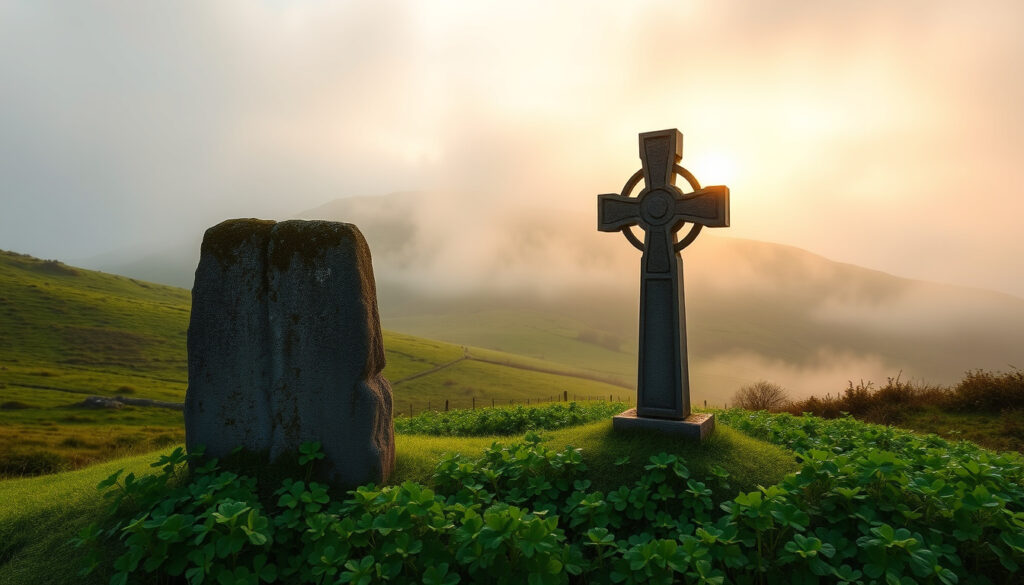
The pattern from Patrick’s own words: he never mentions shamrocks, snakes, or a Celtic cross. Those came centuries later, invented by monks who wanted a more dramatic story. What Patrick does describe is his own loneliness, his prayers, and his stubborn determination to return to the people who enslaved him. For the modern reader—especially in Ireland and the Irish diaspora—the choice is clear: either celebrate the watered-down commercial version, or dig into the gritty, real man whose faith reshaped a nation.
en.wikipedia.org, saintpats.org, epicchq.com, youtube.com, asburyparkstpatricksparade.com, prehlednet.cz
Frequently asked questions
Was St Patrick the first missionary to Ireland?
No. There is evidence of earlier Christians in Ireland, such as Bishop Palladius who was sent in 431 CE (Wikipedia).
Is St Patrick a saint of the Catholic Church?
Yes, but he was never formally canonised under modern rules. He is recognised as a saint by pre-congregation custom (Franciscan Media).
What does the shamrock symbolise on St Patrick’s Day?
Legend says Patrick used it to explain the Trinity, but there is no historical evidence for that. Today it simply represents Irish identity (Discovering Ireland).
Is Saint Brigid still a saint?
Yes, she remains a saint. In 2023 Pope Francis removed her feast day from the universal calendar, but she is still venerated in Ireland (Wikipedia).
Was Donald Trump a Catholic?
No. Donald Trump has self-identified as a Presbyterian and later as non-denominational Christian. He is not a Catholic (Wikipedia).
What does “Kiss me I’m Irish” mean?
It’s a playful American marketing phrase from the 20th century, not a traditional Irish saying. It has no connection to the real St Patrick (Biography.com).
More related posts
 Lloyds Pharmacy Near Me: Stores, Locator & Ireland Guide
 Vanessa Redgrave: Health, Family, Career, and Where She Lives Now
 Julie Graham: Husband, Roles, and Net Worth
 Larry King: Cause of Death, Will Dispute, and Marriages
 Mr Krabs: Good or Evil? Age, Species & Analysis
 Philadelphia Eagles vs Kansas City Chiefs – Chiefs’ 38-35 Win
 Camilla Tominey: Biography, Career, Husband, Children, Age
 Alexander Armstrong: Wife, Net Worth, Royal Ties, Pointless Pay
