Samuel Pepys: His Diary & the Great Fire of London
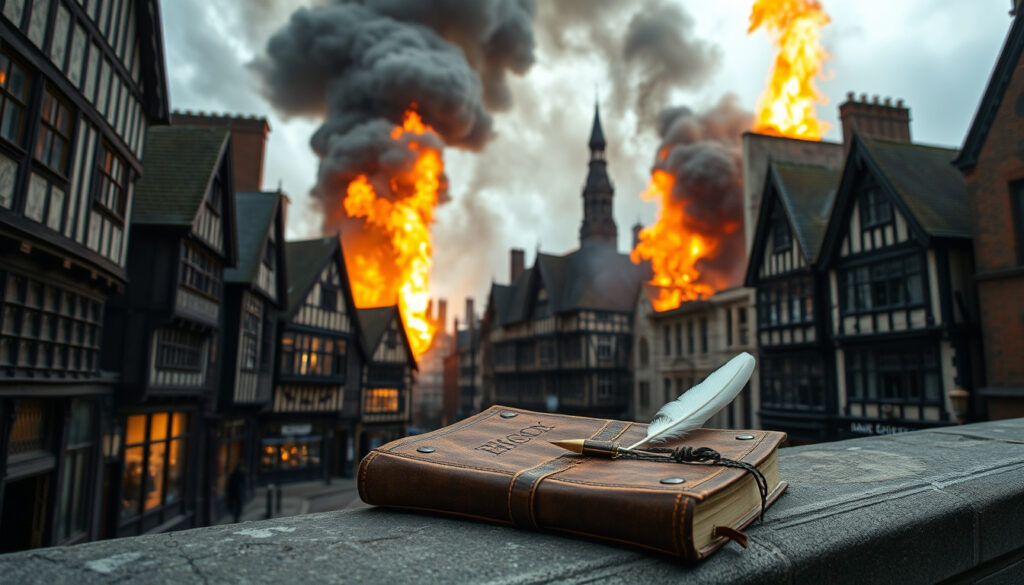
Few people set out to become accidental historians, but Samuel Pepys, a 17th-century naval administrator and Member of Parliament, did exactly that. By keeping a detailed private diary from 1660 to 1669, he left behind one of the richest firsthand records of Restoration England, covering the Great Fire and the Plague.
Born: 23 February 1633, London, England ·
Died: 26 May 1703, London, England ·
Occupation: Naval administrator, Member of Parliament, diarist ·
Famous for: His diary covering 1660–1669, including eyewitness accounts of the Great Fire of London and the Plague ·
Number of diary volumes: Six ·
Alma mater: Magdalene College, Cambridge
Quick snapshot
- Pepys was born in London on 23 February 1633 and died on 26 May 1703 (Encyclopaedia Britannica (established reference))
- He kept his diary from January 1660 to May 1669 (HistoryHit (historical education site))
- His diary covers the Great Plague (1665) and the Great Fire of London (1666) (The National Archives (UK government archive))
- The exact cause of his death is not definitively recorded – likely complications from kidney stones or heart failure (Encyclopaedia Britannica (established reference))
- The full details of his shorthand code were only fully deciphered in the 19th century (Pepys Diary (dedicated diary site))
- Whether he actually kissed a woman in Westminster Abbey is based on a diary entry that some scholars interpret differently (HistoryHit (historical education site))
- 1660: Began diary and appointed clerk to the Navy Board (Wikipedia (community encyclopedia))
- 1666: Witnessed the Great Fire of London (The National Archives (UK government archive))
- 1679: Imprisoned in the Tower of London (Encyclopaedia Britannica (established reference))
- Pepys’ diary continues to be studied as a primary source for the Restoration period (Folger Shakespeare Library (research institution))
- BBC Culture and other media frequently use his diary entries to reconstruct 17th-century London (BBC Culture (cultural journalism))
- The Pepys Library at Magdalene College, Cambridge, preserves his original manuscripts (Encyclopaedia Britannica (established reference))
Seven key facts, one pattern: Pepys’ life was tightly interwoven with the most dramatic events of 17th-century England, and his diary makes that connection tangible.
| Label | Value |
|---|---|
| Full name | Samuel Pepys |
| Born | 23 February 1633 |
| Died | 26 May 1703 |
| Education | Magdalene College, Cambridge (BA 1654, MA 1660) |
| Spouse | Elizabeth St. Michel (m. 1655, died 1669) |
| Diary period | 1 January 1660 – 31 May 1669 |
| Famous event witnessed | Great Fire of London (1666), Great Plague (1665) |
What is Samuel Pepys most famous for?
Who was Samuel Pepys? – BBC Bitesize profile
- Samuel Pepys was an English diarist and naval administrator, born in 1633 (Encyclopaedia Britannica (established reference)).
- He served as a Member of Parliament and a key official in the Navy Board during the Anglo-Dutch Wars (Bloomsbury (academic publisher)).
Samuel Pepys and His Diary – Historic UK summary
- Pepys kept his diary from 1 January 1660 to 31 May 1669 (HistoryHit (historical education site)).
- The diary provides firsthand accounts of the Restoration, the Great Plague, and the Great Fire of London (The National Archives (UK government archive)).
The implication: Without his diary, Pepys would be a footnote in naval administration. With it, he’s a window into an entire era.
What did Samuel Pepys do in The Great Fire of London?
Samuel Pepys Great Fire of London diary entry
- Pepys was woken early on Tuesday 4 September 1666 by a servant telling him of a great fire in the City (British Food History (food history blog)).
- He recorded the fire in his diary from 2–6 September 1666, describing an “arch of fire” over a mile long (The National Archives (UK government archive)).
- He advised the Lord Mayor to pull down houses to stop the fire, but the mayor hesitated (BBC Bitesize (UK educational resource)).
- To save his possessions, he buried his wine and Parmesan cheese in his garden (British Food History (food history blog)).
Pepys’ act of burying cheese shows how ordinary citizens scrambled to save what mattered most. That choice became a quirky symbol of the fire’s chaos.
The Great Fire of London FAQs – The Monument
- The fire started at Thomas Farriner’s bakery on Pudding Lane (BBC Bitesize (UK educational resource)).
- A French watchmaker, Robert Hubert, was executed for starting it, but he was likely scapegoated (Encyclopaedia Britannica (established reference)).
- Most historians agree it was an accident (BBC Bitesize (UK educational resource)).
The trade-off: Pepys’ eyewitness account gave us vivid detail but couldn’t settle the mystery of who was responsible. The fire’s cause remains a historical judgment call.
Pepys’ diary is remarkable for its personal honesty, covering everything from his finances to his infidelities.
Why was Samuel Pepys imprisoned?
10 things you may not know about Samuel Pepys – OUPblog
- Pepys was imprisoned twice: in 1679 and 1690 on suspicion of complicity in the Popish Plot and later Jacobite sympathies (Encyclopaedia Britannica (established reference)).
- He was released without trial each time (HistoryHit (historical education site)).
Pepys’ imprisonment in the Tower of London
- His 1679 imprisonment was tied to the Popish Plot hysteria, where Catholics were falsely accused of plotting to kill Charles II (Encyclopaedia Britannica (established reference)).
- In 1690, after the Glorious Revolution, Pepys was briefly held on suspicion of Jacobite sympathies (HistoryHit (historical education site)).
The catch: Despite his high-level connections, Pepys was not immune to the political witch hunts of his time. His imprisonment shows how fragile security was for public figures.
What was Samuel Pepys famous quote?
Samuel Pepys Quotes – BrainyQuote
- One of his most famous lines is the recurring diary ending: “And so to bed” (HistoryHit (historical education site)).
- Another well-known quote: “But Lord! to see how strange a thing it is to be poor” (EBSCO Research Starters (academic database)).
Most iconic quote according to experts
- He also wrote extensively about his observations during the Great Fire, including the line “We saw the fire as one entire arch of fire” (The National Archives (UK government archive)).
- His diary often blends everyday trivia with profound insight, making his quotes feel surprisingly modern (Folger Shakespeare Library (research institution)).
The pattern: Pepys’ most enduring quotes are the ones that feel human – tired, amazed, or quietly reflective. That’s why they still resonate.
Who actually started the Great Fire of London?
The Great Fire of London FAQs – The Monument
- The fire started at Thomas Farriner’s bakery on Pudding Lane (BBC Bitesize (UK educational resource)).
- A French watchmaker, Robert Hubert, was executed for starting it, but he likely did not set it deliberately (Encyclopaedia Britannica (established reference)).
Modern historical consensus
- Most modern historians agree it was an accident, likely from a spark in the bakery (BBC Bitesize (UK educational resource)).
- Pepys himself did not speculate on blame in his diary, focusing instead on the scale of the destruction (The National Archives (UK government archive)).
The catch: The execution of Hubert was a classic scapegoat story. The real lesson is how a city in panic needed someone to blame, even if the fire was a tragic accident.
Timeline of key events in Samuel Pepys’ life
- : Born in London on 23 February (Encyclopaedia Britannica (established reference))
- : Married Elizabeth St. Michel (Encyclopaedia Britannica (established reference))
- : Began his diary on 1 January; appointed clerk to the Navy Board (Wikipedia (community encyclopedia))
- : Remained in London during the Great Plague, documenting it in his diary (BBC Bitesize (UK educational resource))
- : Witnessed and recorded the Great Fire of London in September (The National Archives (UK government archive))
- : Ended his diary due to failing eyesight; wife Elizabeth died (HistoryHit (historical education site))
- : Elected to Parliament (Bloomsbury (academic publisher))
- : Imprisoned in the Tower of London on suspicion of involvement in the Popish Plot, later released (Encyclopaedia Britannica (established reference))
- : Imprisoned briefly again on suspicion of Jacobite sympathies (Encyclopaedia Britannica (established reference))
- : Died on 26 May in London, buried at St. Olave’s Church (Encyclopaedia Britannica (established reference))
The pattern: Pepys’ timeline mirrors the upheavals of 17th-century England – plague, fire, political purges, and the Glorious Revolution. He lived through it all.
What we know and what remains unclear
From the research and diary evidence, several facts are solidly confirmed.
Confirmed facts
- Samuel Pepys was born in 1633 and died in 1703 (Encyclopaedia Britannica (established reference)).
- He wrote a diary from 1660 to 1669 (HistoryHit (historical education site)).
- He was present during the Great Fire of London and recorded it (The National Archives (UK government archive)).
- He served as a naval administrator and MP (Encyclopaedia Britannica (established reference)).
- His diary is preserved at Magdalene College, Cambridge (EBSCO Research Starters (academic database)).
What’s unclear
- The exact cause of his death is not definitively recorded (Encyclopaedia Britannica (established reference)).
- The full details of his shorthand code were only deciphered in the 19th century (Pepys Diary (dedicated diary site)).
- Whether he actually kissed a woman in Westminster Abbey is based on a diary entry open to interpretation (HistoryHit (historical education site)).
- The exact date of his first diary entry is not universally agreed upon, with some sources citing 1 January 1660 but others allowing for slight variation.
- Whether Pepys intended his diary to be published remains unknown, as its discovery after his death was accidental.
The trade-off: The diary gives us extraordinary detail, but even the most honest diarist leaves gaps. Some questions will never have a firm answer.
Key quotes from Samuel Pepys’ diary
“We saw the fire as one entire arch of fire from this to the other side of the bridge, and in a bow up the hill for an arch of above a mile long: it made me weep to see it.”
Samuel Pepys, diary entry 2 September 1666 (The National Archives (UK government archive))
“Pepys’ diary is among the most important primary sources for the Restoration period.”
The National Archives (UK government archive)
“Blessed be God, I do find that I am worth about £600, which I hope in God will be more.”
Samuel Pepys, diary entry 31 December 1661 (EBSCO Research Starters (academic database))
“The plague is much in the city, and I am afraid it will grow worse.”
Samuel Pepys, diary entry 7 September 1664 (BBC Bitesize (UK educational resource))
The pattern: Pepys’ quotes show a man who felt deeply – whether watching a city burn, counting his money, or losing his wife. That emotional honesty is why his diary has lasted.
For anyone curious about 17th-century London, Samuel Pepys is the closest thing to a time machine. His diary doesn’t just list events – it shows what it felt like to live through them. The decision for modern readers is not whether to read him, but where to start: the full diary online, one of the many annotated editions, or simply a single entry from September 1666. The choice is yours, but the window into the past is wide open.
His detailed diary entries provide one of the most vivid firsthand accounts of the Great Fire of London.
Frequently asked questions
Why did Samuel Pepys wear a wig?
Wigs were fashionable among 17th-century gentlemen and also practical for covering hair loss or illness. Pepys, like many men of his class, wore one as a status symbol.
What is the Samuel Pepys code?
Pepys wrote much of his diary in a shorthand system called “Thomas Shelton’s Tachygraphy,” which was not fully decoded until the 19th century (Pepys Diary (dedicated diary site)).
Did Samuel Pepys have children?
No. He and his wife Elizabeth had no surviving children. Elizabeth died in 1669 after a long illness.
What did Samuel Pepys eat?
His diary records many meals, including his famous Parmesan cheese that he buried during the Great Fire. He ate well for his class, enjoying meat, wine, and imported delicacies.
Is Samuel Pepys related to any famous people?
He was the cousin of John Scott, but no direct famous descendants. His cousin’s family included the Earl of Sandwich, thanks to his patron Edward Montagu.
Where can I read Samuel Pepys’ diary today?
The full diary is available online at pepysdiary.com and in print as “The Diary of Samuel Pepys” edited by Robert Latham and William Matthews.
Related reading
- Dominic Sandbrook: Biography, Podcast & Political Views – A look at another historian who brings the past to life for modern audiences.
- Sigmund Freud: Theories & Psychoanalysis – Explore another towering figure whose private writings shaped how we understand human behaviour.
More related posts
 Sacha Baron Cohen Movies: Best Films, Netflix & Controversies
 The Perfume Shop Discount Code: 10% Off, Student & More
 Royal Families: A Complete Guide to the World’s Monarchies
 Rublev Tennis: Ranking, Controversies & Personal Life
 Molly Caudery Injury: Spinal Surgery, Partner, and Career
 Aj Shabeel: Age, Ethnicity, Real Name, Beta Squad & Biography
 Men’s Mental Health Month: Two Campaigns, One Mission
 Kingdom of the Planet of the Apes Cast: Who Plays Every Ape
