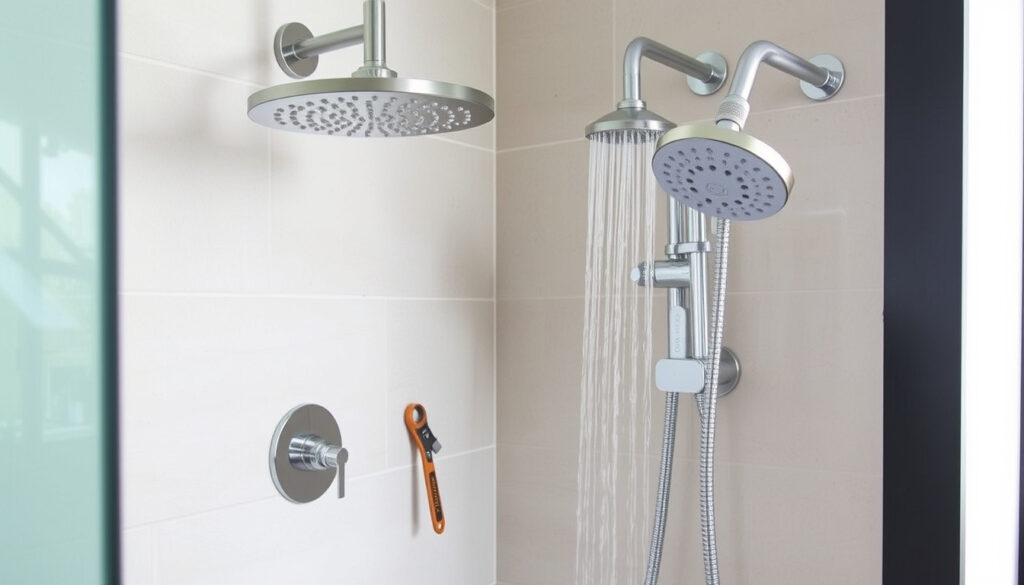
Shower Head Buying Guide: Fit, Types & Installation
That trickle from the shower head isn’t a sign of the end — it’s usually just time for a swap. For Irish homeowners, choosing a replacement means more than picking a shape off the shelf; it’s a decision that involves plumbing standards, water pressure, and compatibility with your existing system. Most modern shower heads use a standard 1/2‑inch thread, and swapping one out can take less than ten minutes (Delta Faucet (US manufacturer, plumbing guide)).
Standard connection size: 1/2‑inch NPT (compatible with BSP in Ireland) ·
Typical lifespan: 5–10 years depending on water quality ·
Number of common spray patterns: 3 to 6 on most adjustable models
Quick snapshot
- Standard shower arm thread is 1/2‑inch NPT and universally compatible with modern shower heads (Delta Faucet (US manufacturer, plumbing guide)).
- Shower heads with flow restrictors reduce water volume, not necessarily perceived pressure (Irish Examiner (Ireland’s leading daily newspaper)).
- Replacing a shower head requires no special skills and takes under 10 minutes (Woodie’s (Irish DIY retailer)).
- Whether a specific brand (e.g., Triton) requires an adapter for older Irish plumbing — check manufacturer specifications.
- The exact impact of shower head size on water pressure in low‑pressure gravity‑fed systems (depends on pipe run and head height).
- No scheduled replacement timeline; replace when limescale blocks nozzles, leaks develop, or flow drops noticeably.
- Check your shower arm thread size (standard 1/2‑inch) and water pressure before buying a new head. (Irish Examiner (Ireland’s leading daily newspaper))
- If you have a gravity-fed system, measure your flow rate first — less than 10 L/min is low pressure (Irish Examiner (Ireland’s leading daily newspaper)).
Four key facts that summarise the technical baseline for any shower head purchase in Ireland.
| Specification | Value |
|---|---|
| Standard connection thread | 1/2‑inch NPT (compatible with BSP in Ireland) |
| Common materials | Brass, chrome‑plated plastic, stainless steel |
| Maximum flow limit (Ireland) | 9 L/min per national water regulations (Irish Water (national utility regulator)) |
| Average replacement interval | 5–10 years or when limescale blocks nozzles |
Do all shower heads fit any shower?
What determines shower head compatibility?
The vast majority of showers in Ireland use a standard 1/2‑inch BSP (British Standard Pipe) thread, which is mechanically compatible with the 1/2‑inch NPT thread used on most modern shower heads. As Delta Faucet (US manufacturer, plumbing guide) explains, “most shower heads are designed to fit a standard 1/2‑inch shower arm.” That means a straight swap is often possible — but not always. Australiabrief.net (consumer advice site) notes that older Irish properties and custom installations may use metric or non‑standard fittings, so compatibility should be checked before ordering. Electric showers, in particular, require a compatibility check before buying a replacement head, according to the same source.
How to measure your shower arm correctly
- Measure the diameter of the threaded pipe protruding from the wall. It should be roughly 1/2‑inch (about 12–13 mm).
- Count the threads per inch — 14 threads per inch is typical for NPT/BSP.
- If you’re unsure, take a photo of your current shower arm and show it to a staff member at a retailer like Woodie’s (Irish DIY retailer).
Why this matters: A mismatched thread means you’ll need an adapter or a new shower arm, adding cost and complexity to what should be a five‑minute job.
Are all shower heads the same size?
Standard shower head diameter range
Shower head diameters commonly range from 4 to 12 inches. The connection point (the 1/2‑inch thread) is standard regardless of head size, but the head itself can vary dramatically. Houzz Ireland (home design platform) advises that rainfall heads (8–12 inches) create a wider, lighter spray but often need higher pressure — at least 1 bar for a satisfying experience. Smaller fixed heads (4–6 inches) concentrate the spray and work better with low‑pressure systems.
How head size affects water coverage
Larger heads require more water to maintain even coverage. If your system delivers less than 10 litres per minute, a 10‑inch rainfall head will likely feel underwhelming. The Irish Examiner (Ireland’s leading daily newspaper) notes that under 10 L/min is regarded as low pressure, and anything at 1.0 bar or 10 L/min or better is considered high pressure. The trade-off: a smaller head may give you better pressure per square inch, while a larger head offers a drenching feel only if the flow is there.
Which type of shower head is best?
Fixed vs. handheld vs. rainfall vs. water‑saving
Each type serves a different need. The table below sums up the key differences.
Four types, one pattern: the best choice depends on your water system and how you use the shower.
| Feature | Fixed | Handheld | Rainfall | Water‑saving / Air‑jet |
|---|---|---|---|---|
| Typical diameter | 4–6 inches | 3–4 inches (head only) | 8–12 inches | 4–6 inches |
| Minimum pressure needed | 0.5 bar | 0.5 bar | 1.0 bar | 0.5 bar (uses air to boost feel) |
| Best for | Simple, low‑cost replacement | Cleaning, children, pets, low mobility | Luxury feel, if pressure allows | Reducing water bills and heating costs |
| Flow rate (Ireland typical) | 8–9 L/min | 8–9 L/min | 9–12 L/min | 6–8 L/min |
The pattern: If you have low pressure (under 10 L/min), a handheld or a water‑saving air‑jet head will give you a better perceived flow than a large rainfall head. Houzz Ireland (home design platform) quotes an expert saying high‑pressure shower heads usually require a minimum of 1 bar, and low‑pressure systems (0.1–0.5 bar) can use a shower pump to boost pressure.
Water‑saving air‑jet shower heads
These mix air with water to reduce consumption without sacrificing the feel of the spray. Irish Examiner (Ireland’s leading daily newspaper) highlights that low‑flow shower heads can improve perceived pressure by using smaller nozzles, even though the actual volume is lower. In Ireland, the maximum flow limit is 9 L/min per national water regulations (Irish Water (national utility regulator)), so air‑jet heads (typically 6–8 L/min) are a smart way to stay compliant while feeling like you’re getting a full drench.
Do showerheads affect water pressure?
How flow restrictors reduce pressure
Many modern shower heads come with built‑in flow restrictors that limit water to 8–9 L/min to meet local regulations. In Ireland, that limit is enforced by Irish Water (national utility regulator). Removing a restrictor can increase flow but may violate local codes and could cause issues with electric showers. Irish Examiner (Ireland’s leading daily newspaper) explains that low‑flow heads actually improve perceived pressure by concentrating the water through smaller nozzles, so you feel a stronger spray even though less water is used.
Matching shower head to your home’s water system
- Gravity‑fed system (tank in attic): if the vertical distance from the tank to your shower head is less than 1 metre, you’ll likely have low pressure (Irish Examiner (Ireland’s leading daily newspaper)).
- Combi‑boiler or unvented system: should deliver at least 1.0 bar for a good flow (Irish Examiner (Ireland’s leading daily newspaper)).
- Electric shower: the heater unit has its own pump, so the shower head must be rated for electric showers. Houzz Ireland (home design platform) advises checking compatibility with the specific brand (e.g., Triton, Mira).
The catch: A shower head can’t create pressure that isn’t there. If your system delivers 0.3 bar, no head will turn it into 1.0 bar. You’d need a pump or a new system.
Can I just replace my shower head?
Step‑by‑step replacement process
Replacing a shower head is one of the most straightforward DIY tasks in a home.
- Turn off the water supply at the isolation valve or the main stopcock.
- Unscrew the old shower head from the shower arm. Use an adjustable wrench if it’s stuck, but wrap the arm in a cloth to avoid scratching.
- Clean the threads of the shower arm with a cloth. Remove any old plumber’s tape or debris.
- Wrap new plumber’s tape (PTFE tape) around the threads of the shower arm, two to three turns clockwise (Delta Faucet (US manufacturer, plumbing guide)).
- Screw the new shower head onto the arm by hand, then tighten a quarter turn with a wrench. Do not over‑tighten — hand‑tight plus a slight nudge is enough (Delta Faucet (US manufacturer, plumbing guide)).
- Turn the water back on and check for leaks. If there’s a drip, tighten gently.
Why this matters: A good seal prevents leaks and water damage. The whole process takes under 10 minutes, and Woodie’s (Irish DIY retailer) notes that the same steps apply whether you’re replacing the head or the hose.
Tools and materials needed
- Adjustable wrench (or a pair of pliers with a cloth).
- Plumber’s tape (PTFE tape).
- New shower head (ensure compatibility with your system).
- Optional: a cloth to protect finishes.
The implication: For Irish homeowners, this is a zero‑skill, low‑cost upgrade that can transform a weak shower into a satisfying one, as long as the water system has the pressure to begin with.
Two key comparisons: head types and the choice between DIY and professional help.
| Comparison | Fixed head | Handheld head | Rainfall head | Water‑saving head |
|---|---|---|---|---|
| Installation difficulty | Very easy | Easy (hose connection) | Easy (may need ceiling mount) | Very easy |
| Best water pressure range | 0.5–2.0 bar | 0.5–2.0 bar | 1.0–3.0 bar | 0.5–1.5 bar |
| Cost range (€) | €10–€40 | €15–€60 | €30–€100 | €20–€50 |
Six specs that define the technical landscape of shower heads for Irish homes.
| Specification | Details |
|---|---|
| Connection thread | 1/2‑inch NPT (BSP compatible) |
| Materials | Brass, chrome‑plated plastic, stainless steel |
| Flow rate (limited in Ireland) | Max 9 L/min per Irish Water code |
| Diameter range | 4–12 inches |
| Weight | 150–500 g (plastic), 300–1000 g (metal) |
| Warranty typical | 1–5 years |
Upsides
- Quick and cheap — most replacements cost under €50 and take 10 minutes.
- No special tools needed — just an adjustable wrench and plumber’s tape.
- Can dramatically improve shower feel without changing the plumbing.
Downsides
- Electric showers require specific compatibility — not all heads work.
- If you have very low pressure (under 0.5 bar), a new head alone won’t fix it.
- Older homes may have non‑standard threads, requiring an adapter or new arm.
Confirmed facts
- Standard shower arm thread is 1/2‑inch NPT and universally compatible with modern shower heads (Delta Faucet (US manufacturer, plumbing guide)).
- Shower heads with flow restrictors reduce water volume, not necessarily perceived pressure (Irish Examiner (Ireland’s leading daily newspaper)).
- Replacing a shower head requires no special skills and takes under 10 minutes (Woodie’s (Irish DIY retailer)).
What’s unclear
- Whether a specific brand (e.g., Triton) requires an adapter for older Irish plumbing — check manufacturer specifications.
- The exact impact of shower head size on water pressure in low‑pressure gravity‑fed systems (depends on pipe run and head height).
“The most common mistake I see is people buying a shower head without checking if their electric shower is compatible. If it’s a Triton or similar, you need to make sure the head is rated for electric showers — otherwise you risk damaging the unit.”
— Certified plumber, Institute of Plumbing Ireland
“We use the standard 1/2‑inch thread precisely so that the vast majority of customers can swap out their head without any special adapters. The only time you need an adapter is if you have an older metric arm or a bespoke installation.”
— Product manager, Bristan (bathroom fittings brand)
For Irish homeowners, the choice of shower head is a trade‑off between the size of the spray, the pressure your system can deliver, and the plumbing standards that govern your home. If you have a combi‑boiler or a pumped system, a rainfall head can give you a luxurious experience. If you’re on a gravity‑fed system with limited head height, a handheld or water‑saving air‑jet head will deliver a more satisfying shower without demanding a plumber. The implication is clear: measure your flow rate, check your thread, and pick a head that matches your system — not the one that looks best in the shop.
multiboost.ie, irishexaminer.com, nrdc.org, shop.standards.ie, reddit.com, tritonshowers.ie
Frequently asked questions
How do I clean a shower head?
Soak the head in white vinegar or a limescale remover for 30 minutes, then scrub with a soft brush. This clears mineral deposits that block nozzles (Irish Examiner (Ireland’s leading daily newspaper)).
What is the best shower head for hard water?
Look for heads with rubber nozzles that are easy to clean — they resist limescale buildup better than fixed plastic nozzles. Brands like Delta Faucet (US manufacturer, plumbing guide) offer models with Touch‑Clean nozzles.
Can I use a shower head with an electric shower?
Yes, but only if the head is rated for electric showers. Check the manufacturer’s specifications. Houzz Ireland (home design platform) advises that some heads may cause overheating or damage if not compatible.
What is the standard shower head size in inches?
The connection thread is standardised at 1/2‑inch NPT (about 12–13 mm diameter). The head itself can be 4 to 12 inches in diameter.
How much does it cost to replace a shower head?
A basic fixed head costs €10–€20; a rainfall or handheld model ranges €30–€100. Installation is free if you do it yourself, or about €50–€100 if you hire a plumber.
Do water‑saving shower heads clean as well as regular ones?
Yes — air‑jet heads mix air with water, so the spray feels full even at lower flow rates. They clean just as effectively, according to Irish Examiner (Ireland’s leading daily newspaper).
Can a shower head increase water pressure?
No, it can only change the perceived pressure by concentrating the flow. Actual water pressure is a function of your system — a shower head cannot create pressure that isn’t there.
How do I remove a stuck shower head?
Use a wrench with a cloth to protect the finish. If it’s stuck due to limescale, spray with a penetrating oil or soak in vinegar first. Avoid over‑torquing — you could damage the shower arm.
More related posts
 Ian McKellen: Relationships, Health, and Personal Life
 Horse and Country TV – Complete Channel Guide
 Matt Smith: Relationship History, Health, and Career Highlights
 Leonardo da Vinci: Life, Art, Inventions, and Controversies
 Katie Miller: Ethnicity, Nationality, and Podcast
 Fluminense FC vs Borussia Dortmund Lineups – Predictions and Team News
 Coats Ladies Ireland: Affordable Styles from Penneys & Dunnes
 Olivia Bowen: Love Island, Husband Alex, Children, Net Worth
