Henry Moore: Biography, Sculptures, WWII Art, and Legacy
Most people know Henry Moore for his monumental bronze sculptures that seem to rise from the earth like ancient bones. But before he became the towering figure of 20th-century British sculpture, Moore spent the Blitz drawing sleeping Londoners in Underground tunnels — an experience that quietly reshaped his artistic vision.
Born: 30 July 1898 ·
Died: 31 August 1986 ·
Number of children: 1 ·
Primary medium: Bronze sculpture ·
Known for: Semi-abstract monumental bronze sculptures
Quick snapshot
- Born 30 July 1898 in Castleford, Yorkshire (Tate (UK national museum of modern art))
- Died 31 August 1986 in Much Hadham, Hertfordshire (Britannica (encyclopedia publisher))
- Official war artist in WWII (Henry Moore Foundation (artist’s official foundation))
- One daughter, Mary Moore (Henry Moore Foundation (artist’s official foundation))
- Exact auction value of individual sculptures (depends on market conditions)
- Full extent of Moore’s private sketchbook output remains undocumented
- Specific reasons for removal of “Large Reclining Figure” from Castleford Civic Centre in 2023 (official statements cite structural concerns, but public speculation persists)
- 1940–1942: Moore creates more than 300 shelter drawings as official war artist (The Tretyakov Gallery Magazine (Russian fine arts publication))
- 1948: International breakthrough at Venice Biennale (The Tretyakov Gallery Magazine (Russian fine arts publication))
- 1977: Establishes Henry Moore Foundation (The Tretyakov Gallery Magazine (Russian fine arts publication))
- Continued research into Moore’s drawings and lesser-known works by the Henry Moore Foundation
- Ongoing museum exhibitions worldwide, including major retrospectives at Tate
Six key facts about Henry Moore at a glance:
| Label | Value |
|---|---|
| Full name | Henry Spencer Moore |
| Born | 30 July 1898, Castleford, Yorkshire |
| Died | 31 August 1986, Much Hadham, Hertfordshire |
| Children | 1 daughter |
| Known for | Semi-abstract monumental bronze sculptures |
| Major museum representation | Tate, Henry Moore Foundation, Museum of Modern Art |
What was Henry Moore best known for?
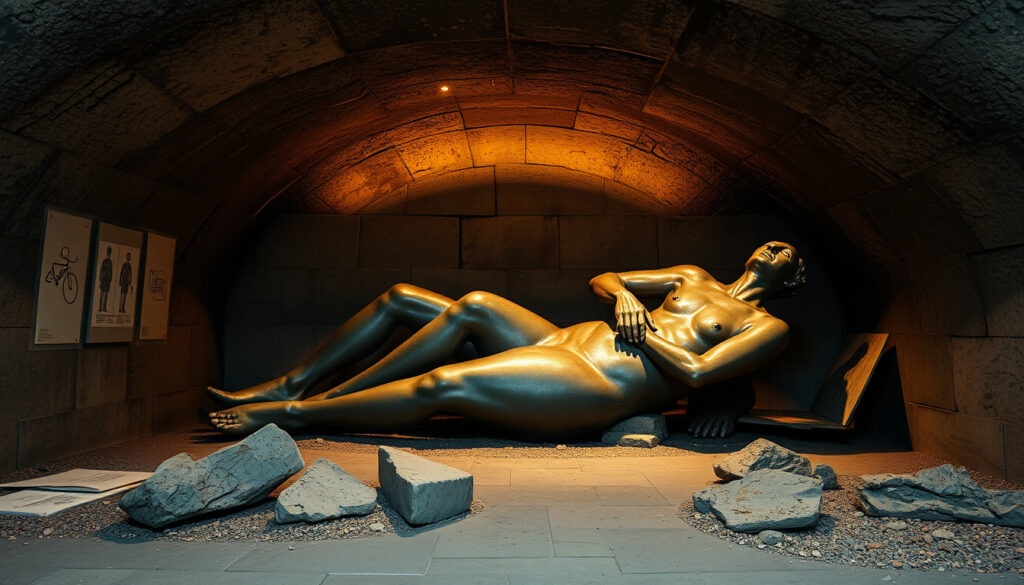
Moore’s artistic identity is inseparable from his semi-abstract bronze sculptures, which dot public spaces from London to Tokyo. According to Tate (UK national museum of modern art), he is best known for semi-abstract monumental bronze sculptures located around the world as public works of art. His style draws deeply from the human body and natural forms — particularly the reclining figure, which he returned to again and again.
What is Henry Moore’s art style?
- Semi-abstract with organic, flowing contours (Britannica (encyclopedia publisher))
- Frequent use of holes (pierced forms) to integrate negative space
- Primary materials: bronze and stone (Britannica (encyclopedia publisher))
- Associated with humanist modernism (Britannica (encyclopedia publisher))
What are Henry Moore’s famous works?
- Recumbent Figure (1938) — one of his most iconic early works
- King and Queen (1952–53) — two seated figures in bronze
- Large Reclining Figure (1982) — a monumental public sculpture
The implication: Moore’s greatest strength is making heavy bronze appear weightless, bending the material to express the human condition in a universal language.
Moore’s work is both ancient and modern — it references prehistoric standing stones while pushing into pure abstraction. That duality is why his sculptures feel at home in a park and a gallery alike.
What did Henry Moore do in WWII?
When war broke out, Moore stayed in London and was appointed an official war artist, first in 1940 according to Christie’s (international auction house), and officially in 1941 as recorded by Henry Moore Foundation (artist’s official foundation). His assignment: document civilians sheltering in London Underground stations during the Blitz.
How did WWII influence Henry Moore’s art?
Between September 1940 and summer 1941, Moore made more than 300 drawings of Londoners sleeping in tube tunnels (The Tretyakov Gallery Magazine (Russian fine arts publication)). These shelter drawings marked a sharp turn from his pre-war abstract sculpture toward a more humanistic, empathetic approach. The Tretyakov Gallery Magazine (Russian fine arts publication) notes that the works made Moore famous beyond the sculpture world.
What did Henry Moore draw during WWII?
- Londoners sheltering in Underground stations during air raids (Tate Kids (UK national museum’s learning portal))
- Coal mining scenes (commissioned by the War Artists’ Advisory Committee)
- Figures huddled in blankets — forms that later influenced his post-war sculptures
What this means: the war gave Moore a subject matter that connected him directly to the public. The shelter drawings are arguably why his post-war public commissions — like the UNESCO Reclining Figure — feel so humane.
How many children did Henry Moore have?
Moore and his wife Irina Radetsky had one daughter, Mary Moore, born in 1946. Mary now chairs the Henry Moore Foundation, which oversees the artist’s legacy and archives (Henry Moore Foundation (artist’s official foundation)).
Did Henry Moore have any children?
Yes, one daughter. The Moores lived a relatively private life in Perry Green, Hertfordshire, where the family home forms part of the foundation’s campus today.
Who is Henry Moore’s daughter?
Mary Moore, born in 1946, is the chair of the Henry Moore Foundation. She has been instrumental in preserving her father’s work and promoting public access to his art.
The catch: Moore’s intense focus on his craft meant his family life remained small and private. The foundation Mary leads now ensures that his studio and home are open to the public, balancing legacy with personal history.
How much are Henry Moore sculptures worth?
Moore’s market spans a wide range. Small bronze maquettes can sell for £10,000–£50,000, while major monumental works fetch seven figures. Christie’s (international auction house), a primary sales channel, regularly handles Moore pieces. The record for a Moore sculpture is believed to be in the multi-million-pound territory at auction.
How are Henry Moore sculptures valued?
Value depends on size, condition, provenance, and the work’s place in his career. A full-size outdoor bronze with strong museum exhibition history commands the highest prices. Auction results from Christie’s (international auction house) provide the most reliable market data.
Where can you sell Henry Moore artwork?
- Primary auction houses: Christie’s, Sotheby’s, Bonhams
- Specialist art dealers with focus on modern British art
- The Henry Moore Foundation offers authentication and provenance research (Henry Moore Foundation (artist’s official foundation))
The catch: the market is small and expert-driven. Sellers should expect rigorous authentication and commission fees of 15–25% at auction. For major pieces, private treaty sales through trusted dealers may yield better net results.
Forgeries and misattributed works do appear. Always request a certificate of authenticity from the Henry Moore Foundation before any high-value transaction. A fake Moore can cost a collector six figures.
Timeline: Henry Moore’s life
- 1898 — Born in Castleford, Yorkshire
- 1917 — Served in WWI, wounded by gas at the Battle of Cambrai (Christie’s (international auction house))
- 1921–1924 — Studied at Royal College of Art
- 1940–1942 — Official war artist; shelter drawings
- 1948 — Venice Biennale prize — international breakthrough
- 1977 — Founded Henry Moore Foundation
- 1986 — Died at home in Perry Green
What we know and what we don’t
Confirmed facts
- Birth and death dates (Tate (UK national museum of modern art), Britannica (encyclopedia publisher))
- Number of children: one daughter (Henry Moore Foundation (artist’s official foundation))
- WWII official war artist role (Henry Moore Foundation (artist’s official foundation))
- Major works: Reclining Figure, King and Queen (Tate (UK national museum of modern art), Britannica (encyclopedia publisher))
- Establishment of Henry Moore Foundation in 1977 (Henry Moore Foundation (artist’s official foundation))
What’s unclear
- Exact value of individual sculptures (auction-dependent)
- Full extent of Moore’s private sketchbook output
- Specific reasons for removal of “Large Reclining Figure” from Castleford Civic Centre (official statements cite structural concerns; public speculation continues)
“The secret of life is to have a task, something you devote your entire life to, something you bring everything to, every minute of the day for your whole life. And the most important thing is – it must be something you cannot possibly do.”
Henry Moore, quoted on Goodreads (reader community platform)
“It is a mistake for a sculptor or a painter to speak or write very often about his job. It releases tension needed for his work.”
Henry Moore, quoted on Goodreads (reader community platform)
For the collector or museum curator, the pattern is clear: Moore’s market is durable but demands caution. Authenticate through the foundation, verify provenance, and treat the rare seven-figure sales as outliers, not the norm.
en.wikipedia.org, heritagecalling.com, tate.org.uk, christies.com, youtube.com, nieuwskader.nl
His wartime sketches of Londoners sheltering in the Underground remain a poignant record of civilian resilience, a body of work explored in depth in Henry Moores war artist legacy.
Frequently asked questions
When was Henry Moore born?
30 July 1898 in Castleford, Yorkshire (Tate (UK national museum of modern art)).
Where was Henry Moore born?
Castleford, Yorkshire, England.
What materials did Henry Moore use?
Bronze and stone were his primary sculptural materials (Britannica (encyclopedia publisher)).
Is Henry Moore considered a modernist?
Yes. His work is associated with humanist modernism (Britannica (encyclopedia publisher)).
What is the Henry Moore Foundation?
A charitable organization founded in 1977 to preserve and promote Moore’s work and support sculpture today (Henry Moore Foundation (artist’s official foundation)).
How many sculptures did Henry Moore create?
Thousands, including small maquettes and large public commissions. An exact count is not recorded.
Where can I see Henry Moore sculptures?
Major collections: Tate (London), Henry Moore Foundation (Perry Green), Museum of Modern Art (New York), and many public parks worldwide.
Did Henry Moore serve in the military?
Yes. He served in the British Army during WWI and was gassed at the Battle of Cambrai (Christie’s (international auction house)).
More related posts
 Machine Gun Kelly Biography: Relationship, Health, Daughter (2025)
 Siobhan Fahey Now: Life, Music, and Where She Lives in 2025
 Alex Jones One Show – Career, Why She Left and What’s Next
 Anna Maxwell Martin: Husband, Children, Career & Life After Loss
 Andrew and Fergie Latest – Shared Home Amid Scandals and Health Woes
 How Many Bank Holiday in 2024? Ireland & UK
 Kate Humble: Biography, Age, Husband, Children & Career
 Sara Sampaio: Angel, Actress, Relationship & Net Worth
