Leonardo da Vinci: Life, Art, Inventions, and Controversies
Mention Leonardo da Vinci, and most people picture the Mona Lisa’s enigmatic smile or a man with a flying machine. But the real story of the Renaissance polymath is messier and more fascinating than the myth.
Born: April 15, 1452, Anchiano, Italy ·
Died: May 2, 1519, Amboise, France ·
Known for: Mona Lisa, The Last Supper, Vitruvian Man ·
Fields: Painting, engineering, anatomy, invention ·
Period: High Renaissance ·
Surviving paintings: Fewer than 20
Quick snapshot
- Born out of wedlock near Vinci, Tuscany (Britannica)
- Painted the Mona Lisa and The Last Supper (Britannica)
- Died in Amboise, France, on May 2, 1519 (Britannica)
- Kept notebooks in mirror writing (BBC)
- Exact cause of death — possible stroke or pneumonia (Britannica)
- Whether he had biological children (Britannica)
- Sexual orientation — debated by historians (Britannica)
- Whether he had ADHD — speculative modern diagnosis (Britannica)
- 1452 — Born in Anchiano, near Vinci (Britannica)
- c. 1466 — Apprenticed to Verrocchio in Florence (Britannica)
- 1482–1499 — Works for Ludovico Sforza in Milan (Britannica)
- 1516–1519 — Lives in France under Francis I (Britannica)
Six key facts about Leonardo da Vinci’s life and work, drawn from authoritative sources.
| Label | Value |
|---|---|
| Full name | Leonardo di ser Piero da Vinci |
| Birth | April 15, 1452, Anchiano, Republic of Florence |
| Death | May 2, 1519, Amboise, Kingdom of France |
| Notable works | Mona Lisa, The Last Supper, Virgin of the Rocks, Lady with an Ermine |
| Fields | Painting, drawing, engineering, anatomy, cartography, architecture, sculpture |
| Patron | Ludovico Sforza (Milan), King Francis I of France |
What is Leonardo da Vinci famous for?
Artistic masterpieces
Leonardo da Vinci is best known for two paintings that have become global icons: the Mona Lisa (c. 1503–1519) and The Last Supper (c. 1495–1498). The Mona Lisa, housed in the Louvre, draws millions of visitors each year, partly because of the subject’s elusive expression and the innovative sfumato technique. The Last Supper, painted on the wall of the refectory of the Convent of Santa Maria delle Grazie in Milan, is celebrated for its composition and emotional depth. Beyond these, Leonardo produced the Vitruvian Man (c. 1490), a drawing that has become a symbol of the blending of art and science, as noted by the National Gallery, London.
Scientific and engineering contributions
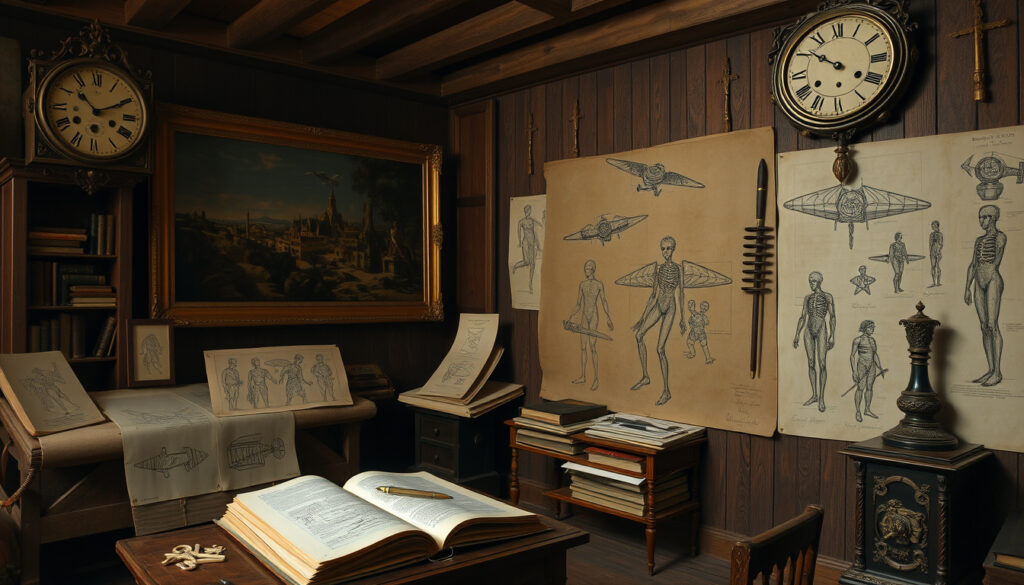
Leonardo’s notebooks reveal a mind that ranged across anatomy, geology, flight, and optics, as documented by the BBC. He dissected human corpses to understand the body’s mechanics, hoping to improve his painting. He also designed a flying machine, a parachute, and an armored vehicle — ideas that were centuries ahead of their time. However, Britannica notes that later scholarship disputes some of the invention claims, especially the bicycle and helicopter, which may have been misattributed.
Legacy as a Renaissance man
Leonardo is often held up as the archetype of the “Renaissance man” — a person of many talents. The National Gallery, London describes him as a painter, sculptor, architect, engineer, and scientist. Yet the same institution points out that many of his works were never finished and fewer than 20 major paintings survive. The pattern: his ambition often exceeded his output, which is part of what makes him so human.
Leonardo’s fame rests on fewer than 20 finished paintings, yet his cultural influence is larger than almost any artist who left behind hundreds of works. The reason: his notebooks reveal a mind that was endlessly curious, and that curiosity itself became part of his legacy.
What are five facts about Leonardo da Vinci?
He was born out of wedlock
Leonardo was born in 1452 near Vinci, Tuscany, the illegitimate son of Ser Piero, a 25-year-old notary, and a peasant woman named Caterina, according to the Museum of Science. This status meant he could not attend a formal Latin school, but it also freed him from following his father’s profession.
He was left-handed and wrote in mirror script
Leonardo was left-handed, and he wrote most of his notes from right to left in a mirror script, as reported by BBC. This has been a source of fascination, though it may simply have been a practical technique to avoid smudging ink.
He was a vegetarian
According to historical accounts, Leonardo had a deep love for animals and was a vegetarian. The Britannica mentions his reported habit of buying caged birds in the market and setting them free.
He spent his final years in France
In 1516, Leonardo accepted an invitation from King Francis I and moved to the Château du Clos Lucé in Amboise, France. He died there on May 2, 1519, at age 67, as recorded by Britannica.
Fewer than 20 paintings survive
The Wikipedia article on Leonardo notes that fewer than 25 major works are attributed to him, with some attributions still debated. The National Gallery states that many of his projects were left unfinished.
What this means: the five facts above show that Leonardo’s life was marked by constraints — his birth, his left-handedness, his unfinished projects — yet he turned each into a creative advantage.
What caused Leonardo da Vinci’s death?
Historical accounts of his final illness
Leonardo da Vinci died on May 2, 1519, in Amboise, France. The Britannica states that the exact cause is not definitively known. The 16th-century biographer Giorgio Vasari wrote that Leonardo had a prolonged illness and received the last rites of the Catholic Church.
Possible stroke or pneumonia
Some modern historians, relying on descriptions of his symptoms, speculate that Leonardo may have had a stroke or pneumonia. However, Britannica notes that there is no contemporary medical record to confirm either diagnosis.
Location of his death
Leonardo died at the Château du Clos Lucé, where he had lived under the patronage of King Francis I. The king reportedly held Leonardo’s head as he died, a story recounted by Vasari and cited by Britannica.
The catch: the cause of death remains one of the enduring mysteries about Leonardo. Without a modern autopsy, any explanation is speculative.
Did Leonardo da Vinci have a child?
No evidence of biological children
There is no historical record that Leonardo da Vinci ever married or fathered a child. The Britannica confirms that no direct descendants exist.
His relationship with apprentice Salai
Leonardo took on a young boy named Gian Giacomo Caprotti, nicknamed Salai (“little devil”), as a pupil in 1490. Salai remained with Leonardo for decades, and some scholars suggest the relationship may have been intimate, though the evidence is circumstantial, as noted by Britannica.
Questions about heirs
Because Leonardo had no children, his estate passed to his pupils and servants. The Britannica notes that the absence of a bloodline has fueled conspiracy theories, but no credible evidence supports the existence of a living da Vinci descendant.
Why this matters: the lack of children means that Leonardo’s genetic legacy died with him, but his artistic and intellectual legacy is more alive than ever.
Was Leonardo da Vinci LGBTQ?
Historical records of relationships
Leonardo never married, and his closest relationships were with men. He was particularly close to his pupil Salai and later to Francesco Melzi, who became his heir. The Britannica notes that these relationships are often cited as evidence of his homosexuality.
Anonymous accusation of sodomy in 1476
In 1476, when Leonardo was 24, he was anonymously accused of sodomy with a 17-year-old male model. The charges were dropped because no witnesses came forward, as recorded by Britannica. This is the closest thing to a legal record of his sexuality.
Contemporary scholarly views
Most modern historians believe Leonardo was likely homosexual, but there is no definitive proof. The Britannica states that the evidence is circumstantial and that the debate is unlikely to be resolved without new documentary discoveries.
The trade-off: we can say that Leonardo’s life included close male companions and a sodomy accusation, but the label “LGBTQ” is a modern construct that doesn’t map neatly onto 15th-century Florence.
Did Leonardo da Vinci have ADHD?
Modern diagnostic speculation
In recent years, some researchers have suggested that Leonardo da Vinci may have had attention deficit hyperactivity disorder (ADHD). The Britannica notes that this is a retrospective diagnosis based on behavioral patterns.
Symptoms observed in his notebooks
Leonardo frequently started projects and left them unfinished. He often jumped from one topic to another in his notebooks, spending years on anatomy, then switching to flight, then to water currents. The Britannica mentions that he had difficulty with sustained focus on a single project.
Counterarguments
Many historians argue that applying a modern clinical diagnosis to a Renaissance figure is problematic. Leonardo’s “distractibility” can also be seen as a sign of extraordinary curiosity. The Britannica points out that there is no way to confirm or refute the ADHD hypothesis.
What to watch: the ADHD speculation is a fascinating lens, but it tells us more about our own era’s desire to categorize genius than about Leonardo himself.
What happened to Leonardo da Vinci when he was 14?
Apprenticeship with Andrea del Verrocchio
Around 1466, when Leonardo was about 14, he became an apprentice in the workshop of Andrea del Verrocchio in Florence, one of the most prestigious art studios in Italy. The Britannica records that this apprenticeship shaped his entire career.
Early artistic training in Florence
In Verrocchio’s workshop, Leonardo learned painting, sculpture, and technical skills such as chemistry, drafting, and metalworking. The Museum of Science notes that this environment provided the foundation for Leonardo’s later work as both artist and engineer.
Significance of this period
Tradition holds that Verrocchio was so impressed by the angel Leonardo painted in his work “The Baptism of Christ” that he never painted again. The Britannica cites this as an early sign of Leonardo’s extraordinary talent.
Leonardo’s age-14 move to Verrocchio’s workshop was the single most important career decision of his life. Without that training, there would be no Mona Lisa, no anatomical drawings, no notebooks. For any aspiring artist or inventor, the lesson is clear: the right environment at the right age can unlock a lifetime of creativity.
The implication: the apprenticeship at 14 was the turning point. It gave Leonardo the technical mastery that would later enable both his art and his science.
Timeline of Leonardo da Vinci’s life
Here is a chronological overview of key milestones in Leonardo’s life.
| Date | Event |
|---|---|
| 1452 | Born in Anchiano, near Vinci, Italy |
| c. 1466 | Apprenticed to Andrea del Verrocchio in Florence |
| 1472 | Qualified as a master in the Guild of Saint Luke |
| 1482–1499 | Worked for Ludovico Sforza in Milan; painted The Last Supper |
| 1500–1506 | Returned to Florence; began Mona Lisa |
| 1508–1513 | Extensive anatomical studies and scientific work |
| 1516–1519 | Lived in France under King Francis I; died May 2, 1519 |
Why this timeline matters: it shows that Leonardo’s most productive period was in Milan, and his final years in France were a retirement of sorts, though he still produced drawings and designed hydraulic projects.
Clarity check: what we know and what we don’t
Confirmed facts
- He was born out of wedlock (Britannica)
- He painted the Mona Lisa and The Last Supper (Britannica)
- He died in Amboise, France in 1519 (Britannica)
- He kept extensive notebooks with mirror writing (BBC)
What’s unclear
- Exact cause of death is unknown (Britannica)
- Whether he had a child is unconfirmed
- His sexual orientation is debated by historians (Britannica)
- Whether he had ADHD cannot be proven
Quotes from and about Leonardo da Vinci
“Leonardo, by the grace of God, was so richly endowed with beauty and grace that his presence lightened the hearts of all who saw him.”
— Giorgio Vasari, biographer, quoted in Britannica
“He had a wonderful intellect and was a great philosopher.”
— King Francis I of France, as recounted by Vasari
Tradition says Verrocchio was so struck by the angel Leonardo painted in “The Baptism of Christ” that he never painted again.
— Anecdote recorded in Britannica
These quotes show the reverence Leonardo inspired in his contemporaries, but also the tendency to mythologize him. The Verrocchio story may be apocryphal, but it captures the sense of awe that surrounded Leonardo even in his own time.
Leonardo da Vinci’s legacy: art, science, and unanswered questions
Leonardo da Vinci remains one of the most studied and debated figures in history. His art continues to draw millions, his notebooks are pored over by scholars, and the controversies around his personal life ensure that new generations keep asking questions. The pattern is clear: Leonardo’s genius was real, but it was also human — he left paintings unfinished, made mistakes, and lived in a time when many of his ideas could not be built. For the modern reader, the lesson is that we can admire the achievement without needing to polish the legend. The trade-off: we get a more honest, more interesting portrait of a man who was, above all, endlessly curious.
britannica.com, kids.britannica.com, museoleonardodavincifirenze.com, livescience.com, mathshistory.st-andrews.ac.uk, bulletinvietnam.org
For a more comprehensive look at his early years and lesser-known works, you can read this detailed biography of Leonardo da Vinci that explores his notebooks and scientific pursuits.
Frequently asked questions
What is the Mona Lisa and why is it so famous?
The Mona Lisa, painted by Leonardo da Vinci between 1503 and 1519, is famous for its subject’s mysterious expression, the use of sfumato technique, and its status as a cultural icon. It is housed in the Louvre Museum in Paris.
How many paintings did Leonardo da Vinci finish?
Fewer than 20 major paintings are attributed to Leonardo, and many of his works were left unfinished. The National Gallery, London notes that his output was small compared to his reputation.
What is Leonardo da Vinci’s most famous invention?
Leonardo’s most famous invention design is the flying machine (ornithopter), though many of his inventions were never built. The parachute, self-propelled cart, and armored vehicle are also well-known, as noted by Britannica.
Why did Leonardo da Vinci write backwards?
Leonardo wrote in mirror script, from right to left, likely because he was left-handed and wanted to avoid smudging ink. The BBC reports that this was a practical habit, not a secret code.
Where is Leonardo da Vinci buried?
Leonardo is buried in the Chapel of Saint-Hubert at the Château d’Amboise in France.
Did Leonardo da Vinci ever marry?
No, Leonardo never married. There is no record of any marriage or long-term relationship with a woman.
Who was Leonardo da Vinci’s patron?
Leonardo’s main patrons were Ludovico Sforza, the Duke of Milan, and later King Francis I of France, who provided him with a residence in Amboise.
What is the Renaissance and how does Leonardo fit into it?
The Renaissance was a period of cultural, artistic, and scientific revival in Europe from the 14th to 17th centuries. Leonardo exemplified the Renaissance ideal of the “universal man” — someone who excelled in multiple disciplines, from art to engineering.
More related posts
 Joe Gomez: Career, Stats, Wife, Parents & Never Scored
 Lola Petticrew: Age, Partner, Movies, and Identity Questions
 Julia Donaldson: Biography, Net Worth, Family & The Gruffalo
 Shannon Matthews Kidnapping: Facts, Siblings, and Aftermath
 Best Time to Visit Maldives: Weather, Costs & Months Guide
 Clothes Bank Near Me: Donation Guide for Ireland (2025)
 Ken Block Death: Snowmobile Accident, Net Worth & Career
 Jeff Daniels: Career, Politics, and Friendship with Jim Carrey
