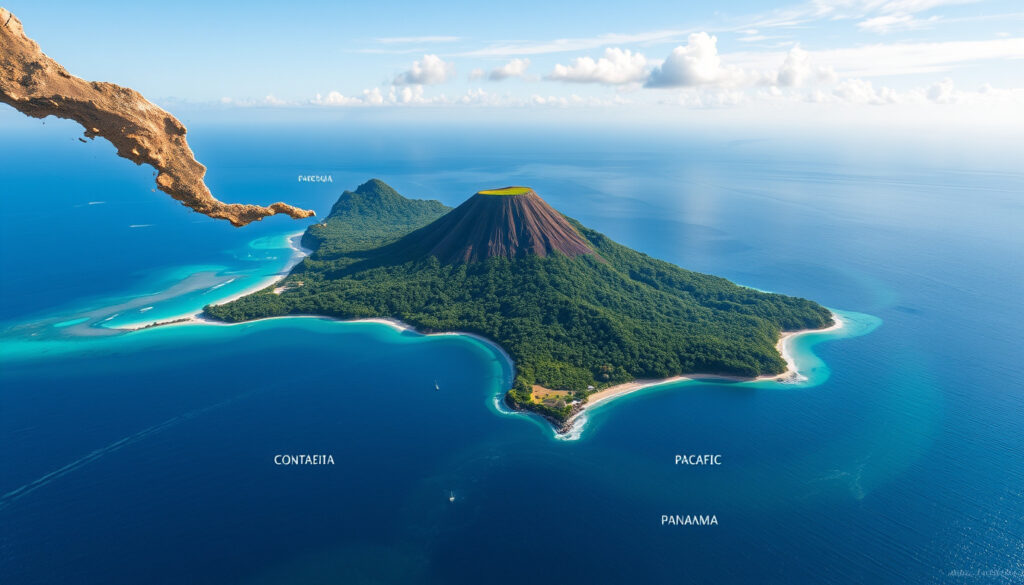
Where Is Costa Rica? Location, Map, Borders & Facts
Costa Rica occupies a narrow land bridge between two oceans and two nations—yet it ranks as Central America’s safest destination and draws more tourists than any of its neighbors. This paradox is what this article examines, starting with where it sits on the globe and ending with what you actually need to know before you go.
Location: Central America · Borders: Nicaragua north, Panama south · Coasts: Caribbean Sea northeast, Pacific Ocean southwest · Capital: San José · Administrative divisions: 7 provinces
Quick snapshot
- 51,100 km² in Central America (Nations Online Project)
- Borders Nicaragua north, Panama southeast (Geology.com)
- Pacific west/southwest, Caribbean east/northeast (World Atlas)
- Granular expat migration trends in 2026
- District-level crime statistics update frequency
- April 2026: U.S. State Department issues Level 2 advisory (U.S. State Department)
- 1949: Costa Rica abolishes standing army (U.S. State Department)
- 2026: Spring break rip current warnings from U.S. Embassy (U.S. State Department)
- Travelers should monitor State.gov advisories before departure
- Safety awareness remains essential in tourist areas
Where Is Costa Rica Located?
Six facts define Costa Rica’s position with precision: one region, two land borders, two coastlines, and one capital that anchors the country’s administrative life.
| Attribute | Value |
|---|---|
| Continent/Region | Central America |
| Northern Border | Nicaragua |
| Southeastern Border | Panama |
| Eastern Coast | Caribbean Sea |
| Western Coast | Pacific Ocean |
| Capital City | San José |
Borders and coasts
Costa Rica occupies the southern portion of the Central American isthmus, wedged between Nicaragua to the north and Panama to the southeast. The country’s western and southwestern shoreline meets the Pacific Ocean, while the eastern edge touches the Caribbean Sea. This dual-coast geography gives Costa Rica a remarkable variety: 630 miles (1,015 km) of Pacific coastline and 185 miles (300 km) of Caribbean shore, compressed into a country slightly smaller than West Virginia at 51,100 km² (Britannica encyclopedia). At its narrowest, the distance between the two oceans is roughly 75 miles (120 km) (Britannica encyclopedia), meaning you can drive from coast to coast in a few hours—though road conditions make that drive genuinely challenging.
Position relative to US and Mexico
Costa Rica is not in Mexico, despite a common misconception that packs it into the same mental category. It sits roughly 1,500 miles (2,400 km) southeast of the southern border of the United States, separated from Mexico by Guatemala and Belize. If you drew a line from Miami to Panama City, Costa Rica falls almost exactly in the middle. It’s the second-most northern country in Central America, after Belize, and the southernmost nation without a Caribbean coastline that borders only one neighbor.
San José location
San José, the capital, sits at approximately 9°56’N, 84°05’W—roughly in the country’s center, though slightly toward the Pacific side. The metro area holds around 2 million people, making it home to roughly 40% of the nation’s population (Wikipedia encyclopedia). This concentration creates both opportunity and risk: the capital is the economic and cultural heart, but also the zone where petty crime is most active.
Is It Safe to Travel to Costa Rica Right Now?
Safety is the question most searchers ask, and it’s the one that demands the most current, source-anchored answer.
Current travel advisory
The U.S. State Department currently rates Costa Rica at Level 2: Exercise Increased Caution, an advisory issued April 2, 2026, citing crime as the primary concern (U.S. State Department official travel advisory). This is not a ban or a warning against travel—Level 2 sits in the middle of the four-tier system—but it signals that visitors should maintain heightened awareness throughout their stay.
Petty crime is common throughout Costa Rica. Violent crime also affects tourists, including armed robbery, homicide, and sexual assault, according to the U.S. State Department travel advisory.
Safety overview
Costa Rica ranks 33rd out of 42 in Berkshire Hathaway’s Safest Places Ratings—making it the safest country in Central America by that measure (Berkshire Hathaway Travel Protection safety analysis). The Global Peace Index backs this up: Costa Rica places 54th out of 163 countries worldwide, again tops in its region (Berkshire Hathaway Travel Protection safety analysis). One structural reason stands out: Costa Rica abolished its standing army in 1949, redirecting military budgets into education and healthcare—factors that correlate strongly with long-term stability and safety outcomes.
Regional leadership in safety doesn’t mean absence of risk. San José carries “considerable risk from crime, especially theft in tourist areas,” per the Overseas Security Advisory Council security bulletin, and road conditions rank among the world’s most challenging per the Government of Canada travel advisory.
What this means: Costa Rica is safer than its neighbors, but not risk-free. The gap between “safest in region” and “safe for every traveler in every situation” is real—and navigable with preparation.
What Is Costa Rica Famous For?
Geography sets the stage; what Costa Rica is known for fills the story.
Top attractions
Costa Rica’s global reputation rests on three pillars: biodiversity, eco-tourism infrastructure, and the ability to experience wild nature without sacrificing comfort. The country dedicates more than 25% of its territory to national parks, wildlife reserves, and protected areas—a figure that ranks among the highest in the world. Volcanoes, cloud forests, and coral reefs coexist within a single small country, making Costa Rica a prototype for sustainable tourism.
Unique features
- No military since 1949—a constitutional choice with no parallel in the region
- “Pura Vida” culture, where the phrase works as greeting, farewell, and state of being
- High proportion of renewable energy from hydroelectric and geothermal sources
- Strong ecotourism credentials:zip-line canopies, sea turtle nesting beaches, wildlife corridors
The paradox: Costa Rica sells itself on peace and nature, yet receives more tourists than almost any other Central American country—over 3 million annually in pre-pandemic years—creating the exact pressures those values are meant to counter.
Is Costa Rica a Rich or Poor Country?
Classifying Costa Rica economically requires context, not a single headline number.
Economy overview
Costa Rica has the sixth-largest economy in Central America and the second-highest GDP per capita in the region after Panama. Its economy is diversified compared to regional neighbors: tourism, agriculture (coffee, bananas, pineapples), technology services, and medical device manufacturing all contribute. The country has attracted foreign investment in high-value sectors, and its human development indicators—life expectancy, literacy, healthcare access—consistently outperform the regional average.
But income inequality persists, and the informal economy absorbs a significant portion of the workforce. For travelers, this manifests in visible contrasts: modern hotels and infrastructure sit alongside areas where economic opportunity remains limited. Costa Rica is neither rich in the developed-world sense nor poor in the subsistence sense—it occupies a middle ground that rewards cultural sensitivity.
What this means: the country has built genuine stability and prosperity, but the distribution means travelers should budget accordingly and understand that service industries depend on tourism dollars that can be fragile.
Costa Rica Travel Essentials: Water, Dress, and Rules
Practical questions surface repeatedly in search data. Here are the grounded answers.
Water safety
Tap water in Costa Rica is generally safe to drink in urban areas, including San José and the tourist corridors along both coasts. However, many travelers and residents prefer bottled water as a precaution against localized issues, particularly in rural areas. Major brands sell bottled water widely; filling reusable bottles from filtered sources is routine among expats. The Berkshire Hathaway travel advisory recommends carrying purification methods when venturing off the tourist grid.
Dress code for women
Costa Rica is casual. Beach towns, national parks, and even city neighborhoods lean heavily toward shorts, t-shirts, and sandals. The “three-finger rule”—a dress code enforced at some upscale restaurants requiring sleeves and cover to the knee—is rare and limited to a handful of venues in San José and Papagayo. Outside those exceptions, women can wear shorts, sundresses, and casual wear freely. Sun protection matters more than modesty.
Beach at night rule
No formal law bans beach access at night, but multiple advisories warn against it. The U.S. Embassy issued a specific warning about rip currents causing multiple drownings annually, with heightened risk during spring break season (U.S. Embassy Costa Rica safety bulletin). Beyond currents, isolated beaches at night lack the foot traffic that naturally deters opportunistic crime. The practical rule: enjoy beaches freely during daylight; leave after sunset.
The upshot: Costa Rica accommodates casual travelers well. The dress code is forgiving, the water is manageable, and the safety gaps close with common sense and awareness of current advisories.
“Driving can be extremely challenging, even to the most experienced driver.”
— Overseas Security Advisory Council (U.S. Government Security Advisory Body)
“There is considerable risk from crime in San José.”
— Overseas Security Advisory Council (U.S. Government Security)
For travelers weighing the draw of Costa Rica’s natural wonders against its real-world risks, the balance tilts favorably—but only with eyes open. The country has built a sustainable tourism industry on the promise of safety and nature; honoring that promise means arriving informed, staying alert, and respecting the conditions that make both possible.
Related reading: Countries of the World · Countries Beginning with Y
Frequently asked questions
Where is Costa Rica currency?
Costa Rica uses the Costa Rican colón (CRC). U.S. dollars are widely accepted in tourist areas, but smaller vendors, taxis, and local markets typically expect colones. ATMs dispense local currency throughout the country.
Where is Costa Rica language?
Spanish is the official language. English is common in tourist zones, but outside those areas, Spanish is essential for basic interactions. Learning key phrases (“gracias,” “por favor,” “pura vida”) is both practical and appreciated.
Is Costa Rica part of the US?
No. Costa Rica is an independent sovereign nation with its own government, constitution, and international status. It is not a U.S. territory, state, or commonwealth. U.S. citizens do not need a visa for stays up to 90 days.
Why are Americans moving out of Costa Rica?
Some U.S. expats cite rising costs in tourist zones, increasing crowding, and limited healthcare infrastructure outside San José as push factors. The “Pura Vida” lifestyle remains a draw, but the reality of daily life—bureaucracy, road conditions, cost of imported goods—causes some to reconsider.
What is the three-finger rule dress code?
The three-finger rule is an informal dress code at some upscale San José restaurants requiring men to wear long pants and closed shoes and women to cover to the knee with sleeves. It applies only to a handful of venues and is not a national law. Most visitors never encounter it.
More related posts
 Why Akshaye Khanna Never Married: His Relationship History
 Harley Quinn: Origin, Story, and Character Profile
 Ayrton Senna: Crash, Last Words, and Unanswered Questions
 Jason Kelce: Biography, Net Worth, Age, Wife & Family
 Justin Baldoni & Blake Lively Legal Dispute Timeline
 Electoral Regi ter Search by Addre : Free Guide Ireland
 Touker Suleyman Net Worth, Businesses and Dragons’ Den Exit
 Samuel Pepys: His Diary & the Great Fire of London
