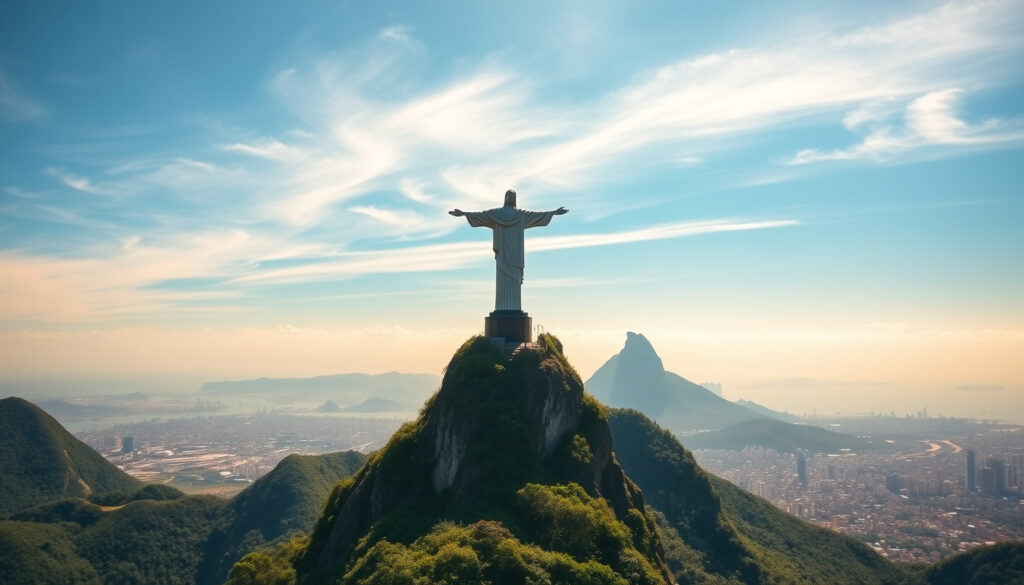
Christ Redeemer Brazil: Facts, History, and Visitor Guide
Few landmarks command the skyline quite like the Christ the Redeemer statue. Perched atop Mount Corcovado in Rio de Janeiro, the 98-foot Art Deco figure has been silently watching over the city since 1931.
Height (statue only): 98 ft (30 m) ·
Arm span: 92 ft (28 m) ·
Weight: 635 tons ·
Year completed: 1931 ·
Location: Mount Corcovado, Rio de Janeiro, Brazil ·
New7Wonders of the World: Yes (2007)
Quick snapshot
- Height 98 ft (30 m) (Encyclopaedia Britannica (reference work))
- Weight 635 tons (Wikipedia (community encyclopedia))
- Completed in 1931 (Encyclopaedia Britannica)
- Art Deco design (Encyclopaedia Britannica)
- Exact number of soapstone tiles: estimates vary around 6 million but not verified (Go Ahead Tours (travel publication))
- Precise original construction cost: around $250,000 reported, but no primary source confirmation (Go Ahead Tours)
- 1926–1931 construction (Wikipedia (community encyclopedia))
- 2007 New7Wonders designation (National Catholic Register (Catholic publication))
- 2014 lightning strike damaged thumb (BBC News (global news service))
- 2020s land dispute emerges (Gospel Herald (religious news))
- Ongoing restoration and maintenance of soapstone surface (Nature Facts (science outreach))
- Potential legal resolution of the land dispute around the monument (Nature Facts (science outreach))
- Continued tourism growth — 2 million+ visitors annually (Nature Facts (science outreach))
Thirteen key specs, one pattern: the numbers reveal a structure built to last, with human-scale details that make it feel both monumental and approachable.
| Attribute | Value |
|---|---|
| Official name | Cristo Redentor (Christ the Redeemer) |
| Location | Mount Corcovado, Rio de Janeiro, Brazil |
| Height (statue) | 98 ft (30 m) |
| Height (including pedestal) | 125 ft (38 m) |
| Arm span | 92 ft (28 m) |
| Weight | 635 tons |
| Material | Reinforced concrete, soapstone tiles |
| Style | Art Deco |
| Sculptor | Paul Landowski (French-Polish) |
| Engineer | Heitor da Silva Costa (Brazilian) |
| Construction years | 1926–1931 |
| Inauguration date | October 12, 1931 |
| New7Wonders of the World | Yes, since 2007 |
Why is Christ the Redeemer famous in Brazil?
What makes it a New7Wonder?
- In 2007, Christ the Redeemer was named one of the New7Wonders of the World via a global public vote (National Catholic Register (Catholic publication)).
- It is the largest Art Deco statue in the world (Encyclopaedia Britannica (reference work)).
- Its hilltop location on Corcovado within Tijuca National Park — a UNESCO Biosphere Reserve — offers panoramic views that make the statue a natural focal point for the city (Wikipedia (community encyclopedia)).
The global vote gave it instant brand recognition, but the real pull is the combination of Art Deco artistry and the drama of the mountain setting. No other wonder blends sculpture and geography so tightly.
How does it symbolize Rio de Janeiro and Brazil?
- The statue is a universal symbol of Christianity and a source of national pride for Brazilians (Encyclopaedia Britannica).
- Its open arms are interpreted as a gesture of welcome to the city and to visitors (Go Ahead Tours (travel publication)).
Why this matters: For Brazilians, the statue isn’t just a tourist attraction — it’s a daily landmark that anchors the city’s identity. The open arms are a literal and figurative embrace of the diverse population that lives below.
What are 5 interesting facts about Christ the Redeemer?
Height and dimensions
- The statue stands 98 ft (30 m) tall, with an arm span of 92 ft (28 m) (Encyclopaedia Britannica).
- Including the 26 ft (8 m) pedestal, the total height is 125 ft (38 m).
Construction materials
- Made of reinforced concrete and covered in soapstone tiles (Wikipedia).
- Soapstone was chosen for its durability and resistance to weathering.
Lightning strike and repairs
- In January 2014, a lightning bolt struck the statue, damaging a thumb (BBC News (global news service)).
- Repairs included new lightning rods and restoration of the soapstone surface.
Art Deco style
- The design is a prime example of Art Deco, a style popular in the 1920s and 1930s (Encyclopaedia Britannica).
- The clean lines and symmetrical proportions reflect the era’s aesthetic.
Sculptor Paul Landowski
- French-Polish sculptor Paul Landowski created the statue’s form (Wikipedia).
- Brazilian engineer Heitor da Silva Costa led the project, and Romanian sculptor Gheorghe Leonida sculpted the face.
How big is Christ the Redeemer?
Comparison to other statues
- It is one of the largest Art Deco statues in the world (Encyclopaedia Britannica).
- For context, the Statue of Liberty (excluding pedestal) is 151 ft (46 m) — Christ the Redeemer is about two-thirds the height of Liberty.
Weight of the statue
- Approximately 635 metric tons (about 1,270,000 lbs) (Wikipedia).
- That’s roughly the weight of 100 adult African elephants.
Scale of the pedestal
- The pedestal is 26 ft (8 m) tall (Encyclopaedia Britannica).
- It provides a base that elevates the statue above the treeline of Tijuca National Park.
The catch: The numbers are impressive, but the real impact is the visual weight of the statue against the mountain. It’s not just tall — it’s perfectly proportioned to the landscape.
Why was Christ the Redeemer built?
Origins of the idea
- Princess Isabel first proposed a religious monument on Corcovado in the 1850s (Encyclopaedia Britannica).
- The idea was revived in the 1920s by the Catholic Circle of Rio de Janeiro.
Construction timeline
- Construction ran from 1926 to 1931 (Wikipedia).
- Inaugurated on October 12, 1931 (BBC News).
Fundraising and community involvement
- The project was funded almost entirely by donations from the local Catholic community (Go Ahead Tours (travel publication)).
- The cost was reportedly around US$250,000 — a significant sum at the time.
Why this matters: The statue was a grassroots project, not a government initiative. That community ownership explains why it remains so deeply woven into the city’s identity.
What happened to Christ the Redeemer statue in Brazil?
Recent land dispute
- In the 2020s, a land dispute emerged over the area surrounding the statue, involving claims by a private landowner (Gospel Herald (religious news)).
- Legal proceedings are ongoing, and the outcome could affect access and maintenance.
Lightning strike and restoration
- The 2014 lightning strike caused a thumb to break off (BBC News).
- Officials replaced the thumb and installed improved lightning rods.
- Some reports indicate the statue is struck an average of six times per year (Gospel Herald).
Vandalism incidents
- Occasional graffiti has been cleaned quickly by maintenance crews.
- No major long-term damage from vandalism has been reported.
The land dispute could become a bigger issue if it restricts access to the statue or escalates into a legal battle that draws in the city government. For now, the statue remains open and fully accessible.
Timeline of Christ the Redeemer
- 1850s — Princess Isabel proposes a religious monument on Corcovado.
- 1920 — Catholic Circle revives the idea.
- 1922 — Fundraising begins; design chosen.
- 1926 — Construction starts under Heitor da Silva Costa.
- 1931, October 12 — Statue unveiled.
- 2007 — Named New7Wonder of the World.
- 2014, January — Lightning strike damages thumb; repaired.
- 2020s — Land dispute emerges.
Clarity check
Confirmed facts
- Statue height: 98 ft (30 m) — Britannica and Wikipedia agree.
- Weight: 635 tons — multiple sources.
- Completed in 1931 — unanimous.
- Art Deco style — confirmed.
- New7Wonders status — official listing.
What’s unclear
- Exact number of soapstone tiles: 6 million cited but not verified.
- Precise construction cost: $250,000 widely reported but no primary source.
Expert perspectives
“Cristo Redentor is an Art Deco statue of Jesus Christ perched atop Mount Corcovado in Rio de Janeiro, Brazil. It is one of the New7Wonders of the World.”
“Christ the Redeemer is a colossal statue of Jesus Christ on top of Mount Corcovado in Rio de Janeiro. It is a symbol of both the city and the country.”
— Encyclopaedia Britannica (reference work)
“The statue was built by the Brazilian engineer Heitor da Silva Costa with the collaboration of French-Polish sculptor Paul Landowski.”
— Wikipedia (community encyclopedia)
For visitors planning a trip to Rio, the message is clear: the Christ the Redeemer statue is worth the journey. But the story behind it — the community fundraising, the lightning strikes, the land dispute — adds a layer of depth that makes the visit more than just a photo op. For anyone interested in how a monument can bridge faith, art, and politics, the statue offers a powerful case study.
ancient-origins.net, softschools.com, independent.co.uk, atlasobscura.com, study.com, naturefacts.net, canadaviewpoint.com
For a deeper dive into the statue’s construction and cultural significance, see this detailed guide on Christ Redeemer Brazil history and facts.
Frequently asked questions
Who designed Christ the Redeemer?
The statue was designed by Brazilian engineer Heitor da Silva Costa, with the sculpted form created by French-Polish sculptor Paul Landowski. The face was sculpted by Romanian artist Gheorghe Leonida.
How long did it take to build the statue?
Construction took five years, from 1926 to 1931.
What is the statue made of?
It is made of reinforced concrete and covered in soapstone tiles.
Can you go inside Christ the Redeemer?
Yes, there is a small chapel inside the pedestal that can host up to 150 people. The statue itself is not hollow, but there is an interior access for maintenance.
How much does it cost to visit Christ the Redeemer?
Ticket prices vary, but typically around R$100–R$150 (Brazilian reais) for a round trip by train. Booking online often offers discounts.
Is Christ the Redeemer the largest statue of Jesus in the world?
No. The Christ the King statue in Poland and the Cristo de la Concordia in Bolivia are taller. But Christ the Redeemer is the largest Art Deco statue of Jesus.
What does the open arms of Christ the Redeemer symbolize?
The open arms are widely interpreted as a gesture of welcome and blessing over the city of Rio de Janeiro and its people.
How often is the statue cleaned and maintained?
Regular maintenance occurs year-round, and a full restoration was undertaken after the 2014 lightning strike. The soapstone surface is cleaned and repointed as needed.
More related posts
 Andrew and Fergie Latest – Shared Home Amid Scandals and Health Woes
 Rag’n’Bone Man: From Care Worker to Chart-Topping Baritone
 Paisley Daily Express Obituaries: Latest Notices & How to Find
 Roy Orbison’s Tragedy: Life, Death & Secret Disability
 Sacha Baron Cohen Movies: Best Films, Netflix & Controversies
 Minka Kelly Biography: Age, Net Worth, Relationships
 FA Cup Semi Final 2026: Dates, Wembley, TV & Prize Money
 Jeremy Bowen: Age, Family, Salary, and Latest Updates 2025
