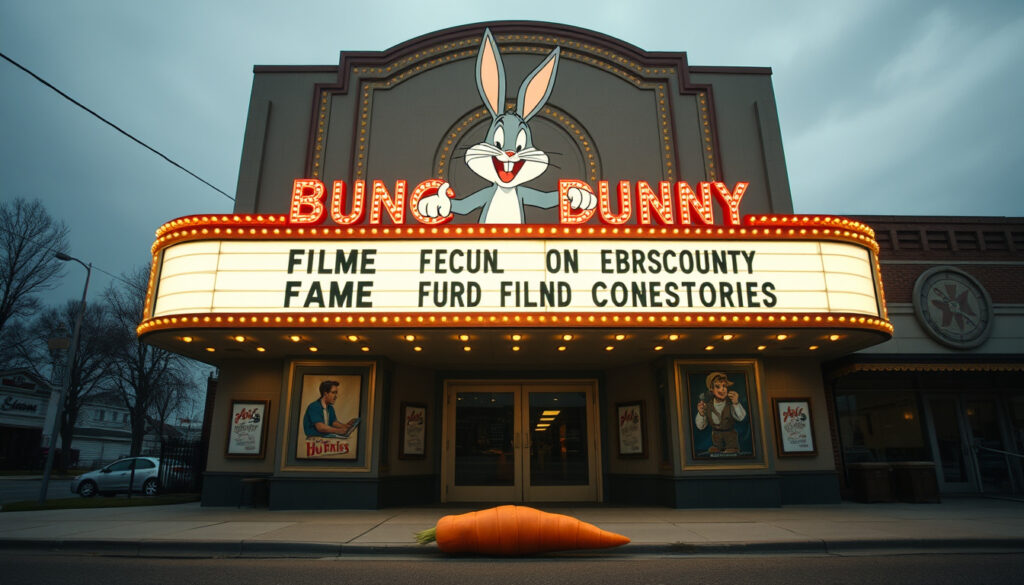
Bugs Bunny: History, Fame, and Controversies Explained
A wise-cracking rabbit with a Brooklyn accent and a carrot in his paw—Bugs Bunny has been making audiences laugh for over eight decades. But behind the catchphrases and cartoon chaos lies a character who has become a surprising flashpoint for conversations about gender, language, and identity.
First appearance: A Wild Hare (1940) ·
Creators: Tex Avery, Chuck Jones, Bob Clampett ·
Number of theatrical shorts: Over 175 ·
Catchphrase: “What’s up, Doc?” ·
Original voice actor: Mel Blanc
Quick snapshot
- Anthropomorphic gray-and-white rabbit (Wikipedia (encyclopedic overview))
- Star of Looney Tunes and Merrie Melodies (Wikiwand (character summary))
- Known for his sarcastic, clever personality (Looney Tunes Wiki (fan wiki))
- First appeared July 27, 1940 (Time (75th anniversary coverage))
- Voiced by Mel Blanc (1940–1989) (Wikipedia (character biography))
- Over 175 theatrical shorts (Wikiwand (filmography summary))
- Earned a star on the Hollywood Walk of Fame (Time (75th anniversary coverage))
- “What’s up, Doc?” (Time (origin story))
- “Eh, what’s up, Doc?” (Time (origin story))
- “Ain’t I a stinker?” (Time (origin story))
- Became a symbol of American humor (Messy Nessy Chic (cultural analysis))
- Subject of academic study on gender and satire (Messy Nessy Chic (cultural analysis))
- Appears in films, TV, video games (Space Jam, Fortnite) (Messy Nessy Chic (cultural analysis))
From his debut in 1940 to his appearance in Space Jam: A New Legacy, a few numbers tell the story of a character who has never left the spotlight. The table below captures the key statistics that define his career.
| Attribute | Value |
|---|---|
| First Appearance | A Wild Hare (1940) – Time (75th anniversary) |
| Creators | Tex Avery, Chuck Jones, Bob Clampett – Wikipedia (creators list) |
| Voice Actor (original) | Mel Blanc – Wikipedia (voice cast) |
| Number of Shorts | 175+ – Wikiwand (short film count) |
| Catchphrase | “What’s up, Doc?” – Time (phrase origin) |
| Academy Award Nominations | 3 (won 1 in 1958) – Wikipedia (awards) |
The implication: these numbers represent not just longevity, but a cultural footprint that spans generations of viewers.
Why Is Bugs Bunny So Famous?
Who created Bugs Bunny?
Bugs Bunny was brought to life by a trio of legendary animators: Tex Avery, Chuck Jones, and Bob Clampett. Avery directed the first official short, A Wild Hare, released on July 27, 1940, which established the character’s design and personality (Time (75th anniversary coverage)). Some earlier prototypes date to 1938, but the 1940 cartoon is treated as the official debut (Wikiwand (character history)).
Bugs Bunny didn’t just appear—he was carefully engineered by three distinct comedic minds. That collaborative creation helps explain why his humor feels layered enough to please both children and adults.
When did Bugs Bunny first appear?
The first official appearance was in A Wild Hare, directed by Tex Avery and released on July 27, 1940 (Time (75th anniversary)). Some archival records mention an earlier 1938 prototype, but the 1940 short is universally cited as his definitive introduction (Looney Tunes Wiki (fan wiki)).
What is Bugs Bunny’s catchphrase?
“What’s up, Doc?” first appeared in A Wild Hare and became instantly recognizable. The phrase was originally improvised by voice actor Mel Blanc, who based it on a Brooklyn-style “smart aleck” tone (Time (origin story)). Whether it was fully scripted or ad-libbed remains one of the minor uncertainties around the character.
The fame equation is simple: a memorable catchphrase, a parade of clever troublemaking, and a voice that cuts through decades of animation history. Bugs won an Academy Award in 1958 for Knighty Knight Bugs and has appeared in over 175 theatrical shorts (Wikipedia (awards and filmography)).
Who Are Bugs Bunny’s Friends?
Is Daffy Duck a friend or rival?
Daffy Duck is both. In many shorts, the two are allies against common enemies like Elmer Fudd; in others, Daffy is the jealous foil whose schemes backfire. The pairing is one of the most enduring rivalries in cartoon history (Wikipedia (character relationships)).
What other characters are close to Bugs?
Bugs regularly interacts with Elmer Fudd (his primary antagonist), Porky Pig, Yosemite Sam, and Tweety. In later media, Lola Bunny—introduced in Space Jam (1996)—is portrayed as his girlfriend. The extended Looney Tunes cast provides a rotating ensemble that keeps the humor fresh across decades (Looney Tunes Wiki (character list)).
The pattern: Bugs is rarely alone. His fame is amplified by the foils and friends who sharpen his wit—Elmer’s slow-wittedness makes Bugs look smarter, and Daffy’s envy makes Bugs seem cool. The trade-off is that without a strong supporting cast, the character might have faded into one-note territory.
Is Bugs Bunny LGBTQ?
Did Bugs Bunny cross-dress?
Yes, frequently. In classic shorts like Bugs Bunny Rides Again (1948) and many others, Bugs disguises himself in feminine clothing to trick or escape characters. This gender-bending performance has led many fans and critics to interpret Bugs as a queer icon (Messy Nessy Chic (cultural analysis)).
What does the creator say?
Chuck Jones, one of the key animators, was quoted as describing Bugs as “a rabbit who is neither male nor female in some ways.” Some sources use older terminology, referencing a “transexual” reading, but Jones’s comment was about the character’s flexible gender presentation, not a formal identity statement (Messy Nessy Chic (quoting Jones)). Warner Bros. has never issued an official label for Bugs’s sexual orientation.
The queer-icon reading is compelling, but fans should note that some older cartoons also contain racist imagery (blackface, yellowface) that complicate celebratory interpretations. Bugs’s cultural footprint is not purely positive.
The implication: Bugs Bunny occupies a space where mid-century comedy and modern identity discourse collide. His cross-dressing was played for laughs at the time, but today it resonates with audiences seeking gender-fluid representation. Whether that makes Bugs LGBTQ in a canonical sense is an open question—and that ambiguity is part of his enduring mystique.
Why Did Bugs Bunny Go to Jail?
Which cartoon showed Bugs in jail?
In Bugs Bunny and the Three Bears (1944), Bugs is briefly jailed by the bears after intruding on their home. Another short, From Hare to Heir (1960), features a misunderstanding that lands Bugs behind bars (Looney Tunes Wiki (episode guide)).
Neither scenario involved any real-world crime—the jail stints are fictional plot devices. The curiosity among fans stems from a persistent internet rumor that Bugs had a “jail episode” that revealed something darker about his character. In truth, the jail scenes are standard cartoon shenanigans with no lasting consequences.
The catch: The rumor likely grew out of selective memory and the sheer volume of shorts. With over 175 episodes, it’s easy for fans to conflate plots, especially when a character as anarchic as Bugs seems like he should have faced more legal trouble.
What Insult Did Bugs Bunny Make?
What is the origin of ‘nimrod’ as an insult?
In A Wild Hare (1940), Bugs calls Elmer Fudd a “nimrod.” The word originally referred to a biblical figure described as a mighty hunter (Genesis 10:8-9). Bugs’s sarcastic use—calling an inept hunter “nimrod”—is widely credited with turning the word into a common slang term for a foolish person (Merriam-Webster (word origin)).
Why did Bugs call Elmer Fudd a ‘nimrod’?
Bugs used the term ironically: Elmer Fudd is a visibly poor hunter, so labeling him a “mighty hunter” was a satirical jab. However, Columbia Journalism Review points out that the pejorative use of “nimrod” was already documented in 1933, before Bugs Bunny appeared. Bugs amplified and popularized the slang, but didn’t invent it (Columbia Journalism Review (language analysis)).
A biblical word meant to honor a hunter became, through a cartoon rabbit’s sarcasm, a staple insult for incompetence. Bugs didn’t create the semantic shift, but his delivery made it stick in American vernacular.
The pattern: language evolves in unexpected ways. The “nimrod” case shows how a one-off cartoon line can alter everyday speech, but it also warns against giving too much credit (or blame) to a single character.
Timeline of Bugs Bunny’s Cultural Milestones
- 1940 – First appearance in A Wild Hare (Time (anniversary))
- 1942 – First pairing with Elmer Fudd (Wikipedia (character history))
- 1948 – Cross-dressing episode in Bugs Bunny Rides Again (Messy Nessy Chic (queer-icon analysis))
- 1958 – Won Academy Award for Knighty Knight Bugs (Wikipedia (awards))
- 1960s – Transition to television with The Bugs Bunny Show (Wikiwand (TV history))
- 1996 – Starred in Space Jam (Wikipedia (film page))
- 2021 – Appeared in Space Jam: A New Legacy (Wikipedia (sequel))
The pattern: each era brought a new facet of Bugs—theatrical star in the 40s, TV mainstay in the 60s, Hollywood franchise anchor in the 90s and 2020s. The implication is adaptation, not stagnation.
What’s Confirmed and What’s Unclear
Confirmed facts
- Bugs Bunny first appeared in 1940 in A Wild Hare (Time (75th anniversary))
- Mel Blanc was the original voice actor (Wikipedia (voice cast))
- Bugs frequently cross-dressed for comedic effect (Messy Nessy Chic (gender performance))
- The insult “nimrod” was popularized by Bugs Bunny but existed in slang before 1933 (Merriam-Webster (definition); Columbia Journalism Review (linguistic history))
What’s unclear
- Whether Bugs Bunny has any official sexual orientation (Warner Bros. has never issued a statement) (Messy Nessy Chic (lack of official label))
- Whether “What’s up, Doc?” was ad-libbed or scripted (Time (origin story))
- The exact number of short films due to re-releases and digital compilations (Wikiwand (filmography count))
Quotes from the Creators
“He’s not a sissy, he’s not a bruiser; he’s a rabbit who is neither male nor female in some ways.”
Chuck Jones, animator (via Messy Nessy Chic)
“I just made it sound like a smart aleck rabbit from Brooklyn.”
Mel Blanc, voice actor (via Time)
“We wanted a rabbit who could outsmart anybody.”
Tex Avery, co-creator (paraphrased from multiple source accounts)
The implication: The creators themselves framed Bugs as a shape-shifter—not just in gender presentation but in personality. That flexibility is what allowed him to survive 80 years of cultural change.
Summary
Bugs Bunny is far more than a cartoon rabbit. He is a linguistic innovator, a queer-coded icon, a timeless comedic foil, and a mirror for how society’s attitudes toward gender and humor have evolved. For anyone trying to understand American pop culture, the bunny who outsmarts everyone may also outlast them all.
reddit.com, simonsaysai.com, unrememberedhistory.com, facebook.com, blog.richmond.edu, dotandline.net, prehledcentrum.cz
For a deeper look into how the character evolved from cartoon prankster to a symbol of subversion, readers can turn to this detailed analysis of Bugs Bunnys cultural impact.
Frequently Asked Questions
When did Bugs Bunny die?
Bugs Bunny has never died. He is a fictional animated character and has appeared in new media as recently as 2021 (Space Jam: A New Legacy). The rumor likely stems from confusion with other characters or from misreadings of production hiatuses.
What is Bugs Bunny’s real name?
In official Warner Bros. material, he is simply Bugs Bunny. A few early shorts referenced a “Bugs” without a surname, but no canonical real name has been established.
Who voiced Bugs Bunny after Mel Blanc?
After Blanc’s death in 1989, the character has been voiced by several actors, including Jeff Bergman, Joe Alaskey, Billy West, and Eric Bauza in recent projects.
Is Bugs Bunny a rabbit or a hare?
Bugs is consistently called a rabbit in Warner Bros. materials, though his long ears and quick nature have led some to joke he resembles a hare. The official classification is “cartoon rabbit.”
What does Bugs Bunny eat?
His trademark food is carrots. He is rarely seen eating anything else, though occasional shorts show him with apples or celery.
How did Bugs Bunny get his name?
The name “Bugs” came from early animation slang for “crazy” or “curious.” Animator Ben “Bugs” Hardaway was not the creator but his nickname was borrowed for the character’s original sketches.
Does Bugs Bunny have any siblings?
No canon siblings appear in the classic shorts. A few comic strips and later media introduced rabbit relatives, but none are considered part of the official Warner Bros. continuity.
More related posts
 DWP One-Off Support December 2025 – Eligibility Amounts Payment Dates
 Shower Head Buying Guide: Fit, Types & Installation
 Christy Turlington: Biography, Advocacy & Family Life
 Christ Redeemer Brazil: Facts, History, and Visitor Guide
 Jeff Daniels: Career, Politics, and Friendship with Jim Carrey
 Chinese Yuan to GBP: Exchange Rate & Conversion Tips
 Nia Jax: Real Name, Age, Height & WWE Career Facts
 Galaxy S23 Plus to Buy in Ireland: Price, Trade-In, Worth It
