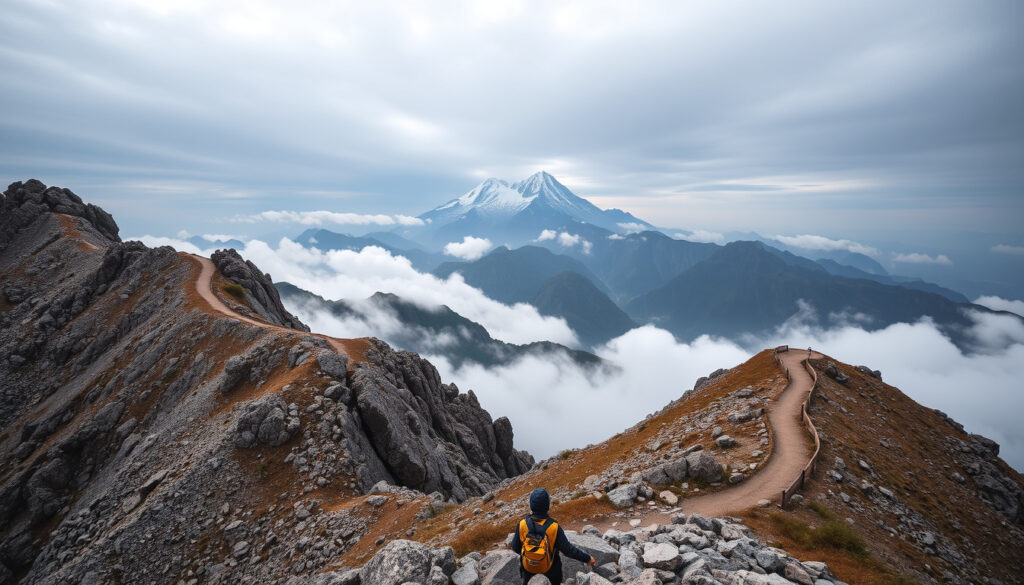
Mount Olympus: Location, Myths & Climbing Guide
Few mountains carry two such different stories as Olympus. On Earth, it’s the legendary home of the Greek gods and a beginner-friendly hiking destination; on Mars, its namesake is a megavolcano that dwarfs everything in the solar system.
Elevation: 2,917 m (9,570 ft) ·
Number of Peaks: 9 ·
First Ascent: 1913 (Christos Kakkalos, Frédéric Boissonnas, Daniel Baud-Bovy) ·
Location: Greece (Thessaly/Macedonia border) ·
Prominence: 2,355 m (7,726 ft) ·
Protected Area: Olympus National Park
Quick snapshot
- Height: 2,917 m (Wikipedia)
- Location: Greece (Thessaly/Macedonia) (Wikipedia)
- 9 peaks, 5 huts, 60 km trails (Much Better Adventures)
- Home of Zeus and the Olympian gods (Discover Greece)
- Throne of Zeus on Mytikas peak (Discover Greece)
- Central to ancient Greek religion (Discover Greece)
- Beginner-friendly with preparation (The Best Viewpoints)
- Average climb time: 6–8 hours up (Much Better Adventures)
- Guided tours and refuges available (The Best Viewpoints)
- Olympus vs Everest: Earth’s highest (Wikipedia)
- Olympus Mons: Mars’ giant volcano (NASA Science)
- Not a volcano itself (Wikipedia)
Four key facts at a glance.
| Attribute | Value |
|---|---|
| Elevation | 2,917 m (9,570 ft) |
| First Ascent | 1913 (Christos Kakkalos et al.) |
| Mountain Type | Orogenic |
| Highest Unclimbed Mountain | Gangkhar Puensum (Bhutan) |
Where is the Olympus Mountain?
Geographic coordinates and region
Mount Olympus is located on the border between Thessaly and Macedonia in northern Greece, about 80 km southwest of Thessaloniki (Wikipedia). Its highest peak, Mytikas, reaches 2,917 metres and is the summit most hikers target. The entire massif falls within Olympus National Park, a protected area established in 1938 that also holds UNESCO Biosphere Reserve status.
How to get there (access points)
- The nearest town is Litochoro, a common overnight stop before the hike. Several guides recommend arriving the night before to get an early start (EIDOLON).
- From Litochoro, a paved road leads to Prionia (1,100 m), the starting point for the main climbing route. A taxi or bus covers the 18 km in about 30 minutes.
The implication: Olympus is one of the most accessible high mountains in Europe—no technical approach, no long trek to base camp.
A first-time visitor can fly into Thessaloniki, sleep in Litochoro, and be on the trail by sunrise. The logistics are far simpler than for most 2,900-metre peaks.
Can a beginner climb Mount Olympus?
Difficulty level and trail options
Yes, absolute beginners can climb Mount Olympus—under the right conditions. The standard route from Prionia is a well-marked trail with a steady gradient, no glacier crossings, and no technical sections. According to The Best Viewpoints (outdoor gear review site), the hike can be approached as a “beginner hiking trip rather than a technical mountaineering objective.” Several travel blogs report that a guide is not strictly required, though hiring one adds safety and context (Solo Female Wanderer).
How many hours does it take to climb Mount Olympus?
- Prionia to Refuge A (Spilios Agapitos): 2–3 hours (700 m elevation gain).
- Refuge A to Mytikas summit: 3–4 hours (rocky terrain, some scrambling).
- Total ascent time: 6–8 hours average (Much Better Adventures (adventure travel magazine)).
- Descent: 4–5 hours.
Most people turn the climb into a two-day affair: sleep at a refuge and summit on day two (The Millennial Abroad (travel blog)).
The trade-off: The easier route means the summit is crowded in summer, and the refuges book out weeks ahead. Beginners gain convenience but lose solitude.
Why is Mount Olympus so famous?
Role in Greek mythology
In ancient Greek religion, Mount Olympus was the domain of the Twelve Olympian gods and, above all, Zeus. The mountain was considered both a physical and divine place—a boundary between earth and the heavens. According to Discover Greece (national tourism authority), the peak of Mytikas is still widely referred to as the Throne of Zeus.
Cultural and historical significance
- It is the highest mountain in Greece, towering over the landscape by more than 2,000 metres of prominence.
- Olympus National Park, designated in 1938, is one of Greece’s oldest protected areas and a UNESCO Biosphere Reserve.
- The mountain has inspired countless works of art, from ancient pottery to modern films and video games.
What this means: Olympus packs two kinds of fame—mythological and geographical—which few other mountains can claim.
What is the myth of Mount Olympus?
Throne of Zeus
The myth holds that Zeus and his fellow Olympians built their palaces on the highest ridges, invisible to mortal eyes. The summit area—particularly Mytikas and the adjacent peak Skolio—is associated with the Throne of Zeus, where the king of the gods would survey the world (Discover Greece (national tourism authority)). Some scholars debate whether the exact “throne” spot was on Mytikas or Skolio, but the legend persists.
What is actually at the top of Mount Olympus?
The summit of Mytikas today holds a metal cross and a small wooden shelter (the “summit refuge”). There is no temple or palace. What visitors find is a rocky peak with panoramic views of the Aegean Sea and the Greek mainland. Near the top, hikers also encounter the Plateau of the Muses, a grassy area that connects several trails across the Olympus massif (Explore-Share (tour operator)).
The catch: The magic of the myth meets the reality of a rocky peak—but the view alone explains why the ancient Greeks chose this place as the home of gods.
Is Olympus higher than Everest?
Comparison with Everest (Earth)
No. Mount Everest reaches 8,848 metres above sea level, more than three times the height of Olympus (2,917 m). But Olympus has a far greater prominence in its local context—its base is at sea level, giving it a rise of nearly 3,000 metres. Everest’s base sits on the Tibetan Plateau at about 5,200 m.
Olympus Mons on Mars
Olympus Mons is the largest volcano in the solar system, standing 21.9 km high—roughly 2.5 times the height of Everest. According to NASA Science (U.S. space agency), it is a shield volcano formed by repeated lava flows over billions of years. Its sheer scale dwarfs any mountain on Earth.
Is Mount Olympus a volcano?
No. Mount Olympus in Greece is an orogenic mountain, formed by the collision of tectonic plates. It is not volcanic and has never erupted. The name confusion comes only from the Martian namesake.
Why this matters: The two Olympus peaks—one on Earth, one on Mars—make for a staggering contrast in scale: the Greek mountain would fit into the Martian volcano’s caldera with room to spare.
On the same search results, a beginner hiker plans a trip to the “Throne of Zeus” while a planetary scientist studies the biggest volcano in the solar system. The name Olympus connects both worlds.
How Mount Olympus, Everest, and Olympus Mons Compare
Three mountains, three orders of magnitude—this table shows the raw numbers side by side.
| Feature | Mount Olympus (Greece) | Mount Everest (Earth) | Olympus Mons (Mars) |
|---|---|---|---|
| Height | 2,917 m | 8,848 m | 21.9 km |
| Type | Orogenic | Orogenic | Shield volcano |
| Location | Greece | Nepal/Tibet | Mars (Tharsis region) |
| First Ascent | 1913 | 1953 | Unclimbed (robotic missions only) |
| Prominence | 2,355 m | 8,848 m | ~21.9 km |
Mount Olympus Specifications
Six specs that define the mountain’s character and shape.
| Specification | Detail |
|---|---|
| Elevation | 2,917 m (9,570 ft) |
| Prominence | 2,355 m (7,726 ft) |
| Location | 40°05′N 22°21′E |
| Number of peaks | 9 (main peaks) |
| First recorded ascent | 2 August 1913 |
| Mountain type | Orogenic (fold mountain) |
| Protected area | Olympus National Park (since 1938) |
| Trail network | ~60 km of marked trails |
| Mountain refuges | 5 (including Spilios Agapitos, Giosos Apostolidis) |
| Best climbing season | June–September |
Pros and Cons of Climbing Mount Olympus
Upsides
- Non-technical trail suitable for beginners with good fitness
- Well-developed refuge network (no tent required)
- Rich mythological and historical context
- Accessible from Athens or Thessaloniki within a day
Downsides
- Summer crowds on main trails and at refuges
- Weather can change rapidly; some sections have loose scree
- Limited guided availability in peak season
- No summit facilities beyond a cross and small shelter
How to Climb Mount Olympus: A Step-by-Step Plan
Step 1: Prepare physically and logistically
- Fitness: Be comfortable walking 6–8 hours with a 10 kg pack on steep terrain.
- Booking: Reserve a bunk at Refuge A (Spilios Agapitos) weeks in advance during summer (Much Better Adventures (adventure travel magazine)).
- Gear: Sturdy hiking boots, rain jacket, headlamp, 2–3 litres of water, snacks.
Step 2: Get to Litochoro and Prionia
Take a bus or car from Thessaloniki (1.5 hours) to Litochoro. Stay overnight. The next morning, drive or take a taxi to Prionia (1,100 m).
Step 3: Hike to Refuge A
From Prionia, follow the well-marked E4 trail through forest and switchbacks. Gain 700 m in about 2–3 hours. Check in at Refuge A (2,100 m).
Step 4: Summit Mytikas (second day)
Start before dawn. The trail becomes rockier and steeper, with some scrambling sections. Reach Mytikas (2,917 m) after 3–4 hours. Descend the same route to Prionia (4–5 hours).
Step 5: Return to Litochoro
A taxi from Prionia back to Litochoro takes 30 minutes. Celebrate with a meal in the town square.
What to watch: Afternoon thunderstorms are common in summer. Aim to be off the summit by midday.
What We Know and What’s Unclear
Confirmed facts
- Height and location are precisely measured (Wikipedia).
- First ascent date and names (Kakkalos, Boissonnas, Baud-Bovy) are documented.
- Mount Olympus is not a volcano (Rice University EEPS).
What’s unclear
- Exact number of annual climbers (estimates vary from 20,000 to 50,000).
- Whether the original “Throne of Zeus” site is on Mytikas or Skolio.
- How many hikers attempt the summit without a guide each year (no official registry).
Perspectives from Two Worlds
“Mount Olympus is not just a mountain—it’s an archaeological and historical site of outstanding universal value, inextricably linked to the birth of Western civilisation.”
— Greek Ministry of Culture (in official designation statement)
“Olympus Mons is so large that its summit rises above the Martian dust storms. Its caldera alone could swallow the entire island of Hawaii.”
Summary: The Dual Legacy of Olympus
Climbing Mount Olympus offers a rare blend: a straightforward alpine hike for beginners and a direct link to the myths that shaped Western culture. Meanwhile, its namesake on Mars represents the outer limit of scale in the solar system. For a traveller planning a trip to Greece, the choice is not between mythology and hiking—the mountain delivers both. For a science enthusiast, Olympus Mons serves as a humbling reminder of how small Earth’s peaks really are.
For those planning a visit, a comprehensive Mount Olympus climbing guide offers practical tips alongside the rich mythology.
Frequently asked questions
How long does it take to climb Mount Olympus?
A typical two-day itinerary: 6–8 hours up to the summit on day one (with a night at a refuge) and 4–5 hours descent on day two.
Do I need a guide to climb Mount Olympus?
No, the main route from Prionia is well marked and can be done independently. However, a guide is recommended for inexperienced hikers or those wanting to learn the mythology on site.
What equipment is required for climbing Mount Olympus?
Sturdy hiking boots, warm layers, rain jacket, headlamp, 2–3L of water, snacks, and a sleeping bag liner if staying at a refuge. No technical gear like ropes or crampons in summer.
Is there an entrance fee for Mount Olympus National Park?
No, the park is free to enter. However, refuges charge for overnight stays (typically €15–€20 per person).
Can I see the Throne of Zeus at the summit?
There is no physical throne. The name refers to the mythic association of Mytikas peak with Zeus. Hikers can stand on the same rocky summit where the ancients imagined the god sitting.
What is the best time of year to climb Mount Olympus?
June through September is the safest period. Outside these months, snow and ice can make the trail hazardous for beginners.
Are there huts or shelters on the trail?
Yes, five refuges operate at different elevations. Refuge A (Spilios Agapitos, 2,100 m) is the most popular and offers sleeping quarters, meals, and water.
Related reading
More related posts
 Tattoos Designs Guide: Popular Styles, 2026 Trends & What to Avoid
 Silent Witness Season 26: Cast, Episodes, Plot & Release Date
 Bugs Bunny: History, Fame, and Controversies Explained
 Levi Ackerman: Biography, Powers, Relationships & Fate
 Choppy Short Layered Bob – Styling Guide and 2025 Trends
 Brandon Sklenar: Bio, Age, Height, Wife, Movies & TV Shows
 On the Beach Holidays Lanzarote – Best Beaches for Families
 Drew Barrymore: Bio, Age, Children, Net Worth, and Health Scare
